Meridian Space reaches orbit. Our First Customer Link mission has launched successfully, with our proprietary communications payload now activated in low Earth orbit.
Our First Customer Link mission has launched successfully. Meridian Space reaches orbit.
Pioneering the next generation of satellite broadband.
Newsroom
Read the latest on how Meridian Space and Spinlaunch are creating new possibilities for the most cost-efficient sovereign Space infrastructure.
Previous
Next
Oct 2, 2026
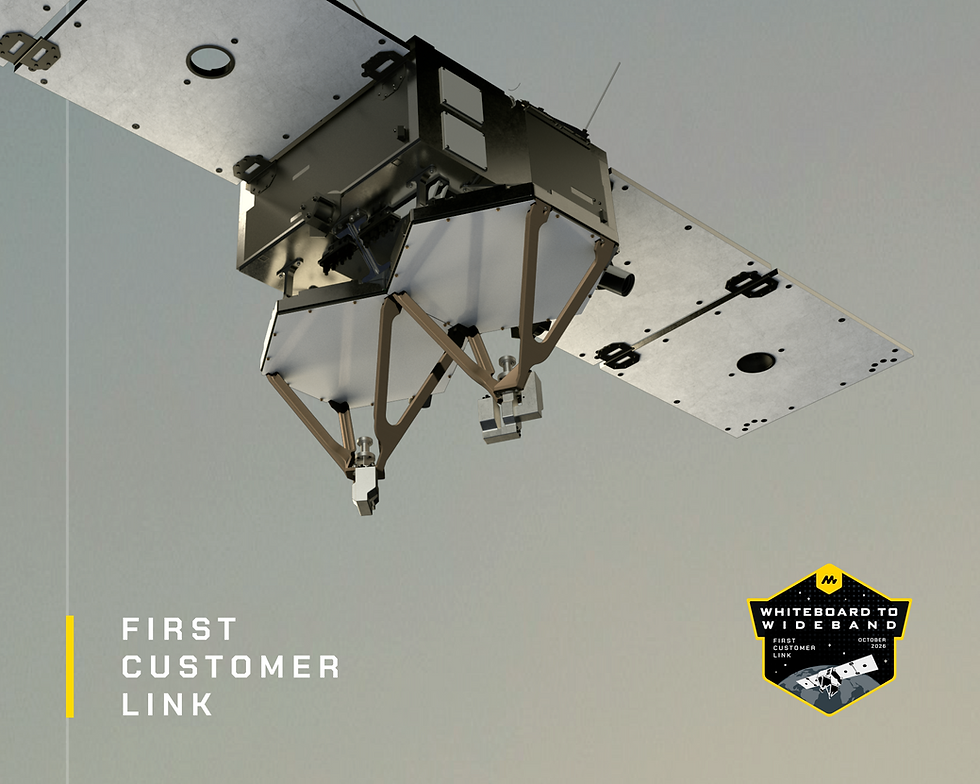
Meridian Space Successfully Activates its First Communications Payload in Orbit
Milestone marks the culmination of five years of proprietary antenna development and establishes the foundation for Meridian's next-generation LEO networks. LONG BEACH, Calif., October 2nd, 2026 – Meridian Space, the space infrastructure company enabling governments and commercial organizations to own and control their own low Earth orbit (LEO) satellite networks, today announced the successful initial activation of its first communications payload in orbit. Launched aboard SpaceX's Transporter-18 mission from Vandenberg Space Force Base on October 1, Meridian's First Customer Link (FCL) mission represents the company's first deployment of its novel reflectarray antenna technology in space, following five years of development, engineering and qualification. At the heart of FCL is Meridian's lightweight, electronically reconfigurable reflectarray antenna, designed to deliver high-performance communications while significantly reducing satellite mass and power requirements. The technology enables smaller, more efficient satellites, reducing the cost and complexity of establishing dedicated LEO networks and making satellite ownership more accessible to governments and commercial organizations. "Seeing our technology successfully deployed and powered on in orbit is a tremendous achievement for Meridian and our team," said Massimiliano Ladovaz, CEO of Meridian Space. "But what excites me most is what comes next. We're building a fundamentally different model for satellite connectivity, one where customers own their networks rather than lease capacity from someone else. This is the milestone that makes the vision a commercial reality." Beyond its initial commissioning, FCL will support early customer demonstrations and trials. The mission is designed to support downlink speeds of up to 1.1 Gbps and will enable Meridian to validate the critical communications technologies underpinning its commercial satellite systems, including its proprietary antenna technology, payload operations and ground infrastructure. The first communications link using Meridian's proprietary payload is planned for the coming weeks. The FCL mission carries Meridian's proprietary communications payload aboard Kongsberg NanoAvionics' MP42 satellite platform. Additional details about the spacecraft platform are available in NanoAvionics' press release. The technologies being validated through FCL will underpin two complementary offerings: Meridian Express and Meridian's next-generation LEO constellation architecture. Meridian Express is a standardized, rapidly deployable constellation offering designed for commercial and defense applications, particularly in critical environments where secure, dedicated communications infrastructure must be established quickly. Building on the communications technology being validated through FCL, Meridian Express provides customers with a faster, more accessible path to owning and operating dedicated LEO networks, with satellite deliveries expected to begin in 2027. For customers requiring larger-scale networks, Meridian is developing its baseline constellation architecture, designed to deliver high-capacity broadband connectivity through purpose-built, customer-owned satellite infrastructure. Leveraging the same core communications technology being validated through FCL, the system's compact satellite design enables significantly more satellites to be accommodated on each launch, reducing deployment costs and the number of launches required to establish a constellation. Watch Meridian Space CEO, Massimiliano Ladovaz, as he introduces Meridian Space and why it is a game changer in LEO satellite communications.
Sep 28, 2026

Exclusive: Meridian Space Spins Out from SpinLaunch
SpinLaunch, the CA-based startup best known for its development of a kinetic launch system, has been working on satcom technology since 2020—under a unit later called Meridian Space. As of today, those business lines are going their separate ways. “SpinLaunch and Meridian Space are separating into two independent companies,” Meridian Space CEO Massimiliano Ladovaz told Payload. “Meridian will carry forward the satcom infrastructure business…SpinLaunch will continue to build on its vision for a lower-cost approach to launch, with further applications in hypersonics to support the Golden Dome program and in the lunar economy.” Call me maybe: The split comes just weeks before Meridian’s first in-space demo, which is expected to launch on SpaceX’s Transporter-18 rideshare NET Oct. 1. The sat aims to demonstrate the first customer link of Meridian’s in-house-developed reflect-array technology, which company officials say uses less power than existing satcom payloads. With less power and space needed to operate and house the antenna, Meridian officials believe the company can fly satellites that are lighter and smaller than other satcom sats in the market—and pass those savings onto customers. “Power is the thing that you want to preserve in space,” Ladovaz told Payload. “[If] you can deliver very high capacity, very flexibly, at a fraction of the power…then the satellites can be very small, and therefore, you can launch them in fewer launches.” Meridian’s long-term goal is to fly its reflect-array antenna on flat satellite buses, making the deployment of a full 250+-sat-constellation possible on just one dedicated launch. In the shorter term, however, Meridian is offering customers the ability to fly the payload on traditional cubesat buses—under a program called Meridian Express, which could be ready to launch next year. Go fast, go alone: Meridian is actively working on signing its first customers, according to Ladovaz. The company is targeting sovereign governments, regional operators, and telecom companies who want to own and operate a satcom network independently. At a time when those wanting to own their own satcom networks are forced to either sign on to global networks like SpaceX Starlink or Amazon Leo, or spend potentially billions to build their own, Meridian aims to offer customers a third path. Meridian’s technology is designed to be built easily by partners. So while Meridian has signed a deal to build its first batch of sats on NanoAvionics buses, the tech opens the door for sovereign-satcom systems to be built in any country a future customer might want. “This is about ownership, control, and the fact that we sell custom-made systems to customers,” Ladovaz told Payload. “We can build a system for less than a billion dollars. That includes the space segment, launch, and ground.” To the Moon: SpinLaunch will share more details about its “leadership, vision, and plans in the near future,” according to Ladovaz. However, the company was awarded a patent last year—covering a kinetic launcher “anchored on to a planetary body with a rarified atmosphere…”—suggesting SpinLaunch’s future may lie off-world, sending payloads from the Moon back to Earth, or further into deep space.
Sep 27, 2026

Meridian Space splits from SpinLaunch to pursue broadband constellation plans
TAMPA, Fla. — Meridian Space has split from kinetic launch technology developer SpinLaunch as it seeks more funding to develop flat satellites it says could launch up to 250 at a time on a Falcon 9, enough for global broadband coverage. “SpinLaunch and Meridian are separating into two independent companies, each with a distinct focus and its own path forward,” Meridian said in a statement to media. “Meridian will carry forward the satcom infrastructure business which it has actively developed for the past several years. SpinLaunch is entering its next chapter with a renewed focus on advancing and commercializing its kinetic launch technology.” The corporate split became official Sept. 21, according to a Meridian spokesperson. SpinLaunch will continue developing an alternative launch system that has involved using a centrifuge to accelerate vehicles to hypersonic speeds to effectively replace a conventional rocket’s first stage, the spokesperson said, while also pursuing hypersonics technologies to support the U.S. Golden Dome missile defense program. SpinLaunch is also exploring applications for its technology in a future lunar economy. “The company has been assembling a dedicated team around the mission who are shaping SpinLaunch’s strategy and priorities, and will be sharing more about its leadership, vision, and plans in the near future,” the Meridian spokesperson added. Last year, SpinLaunch announced it had raised $30 million in a funding round led by ATW Partners to help build out a broadband constellation, including a $12 million investment from Norway’s Kongsberg Defence and Aerospace. NanoAvionics, Kongsberg’s Lithuanian small satellite manufacturing unit, has signed a 122.5 million euro ($139 million) contract to deliver 280 satellites for Meridian. Massimiliano Ladovaz, the former chief technology officer of OneWeb, joined as Meridian’s CEO a few months later. Meridian’s aim to develop 70-kilogram satellites that, when stowed for launch, would be less than two meters wide, a little over a meter and a half tall and 30-40 centimeters thick hinges on a low-profile antenna slated to fly on SpaceX’s next rideshare mission Oct. 1. The antenna has been integrated with a standard cubesat from NanoAvionics to test a capability Ladovaz says would enable the thin satellite version to deliver “very high capacity, similar to any other broadband satellite,” while being 20 times more power efficient than legacy satellites in low Earth orbit (LEO). “There’s an advantage to not being first: you can look at everything that was done before,” Ladovaz told SpaceNews via email. “The team looked at the LEO constellations already being built and asked where the cost and complexity were coming from. One answer was the payload. By developing a high-performance, low-power antenna, we can build much smaller satellites.” According to Meridian, this reduces the capital needed for a constellation, along with the number of rockets needed to put it in orbit, as SpaceX’s shift from its Falcon 9 workhorse to Starship development looks set to worsen an already constrained supply for launch capacity. “This is now even more relevant as SpaceX looks to reduce the number of launches it makes available,” Ladovaz added. “We designed the technology to address the cost, but it now also helps address a challenging launch market.”
Feb 22, 2026

10 Hottest Companies in Satellite for 2026
Via Satellite's annual list of the 10 Hottest Companies in Satellite
View Here Via Satellite’s annual 10 Hottest Companies rounds up 10 “must watch” companies in the satellite industry, from constellations, manufacturing, launch, and more. Via Satellite editors chose the companies on this list based on their expected activity for the year, and a mix of market share, transformational technology, ground-breaking deals, and overall industry excitement. Since 2019, the annual list has highlighted more than 70 companies. The companies selected as the 2026 10 Hottest Companies in Satellite are listed here in alphabetical order: AIRBUS/LEONARDO/THALES SPACE MERGER Europe is a growing hotspot for space investment as governments realize they need more locally developed tech going forward. Airbus, Leonardo, and Thales signed a memorandum of understanding (MoU) late last year to create a leading European player in space and bring their space businesses together. The combined entity will employ around 25,000 people across Europe. This merger gives Europe a player with immense size and scale that can compete in many markets and far more on a global stage than ever before. Carla Filotico, partner and managing director of Novaspace, called it a “bold and necessary move,” and she said the new company can create “scale, coherence and speed.” The move represents a new era when it comes to European space. Europe has many space companies, but none with this level of scale. This new company should help with sovereign strategies across Europe and the new company can play a key role in fostering innovation across the continent. While this new company will be a large player, maintaining agility will be essential. Can it develop new products and solutions at speed? Can it work with European startups and help power the overall European space ecosystem and strengthen European space supply chains? Can it keep pace with the likes of SpaceX and Amazon on a global stage or will it be slow to react to the fast evolutions in the global space market? There are many questions but there is no doubt the eyes of the satellite world will be on this new company. It could be the catalyst for Europe to realize its overall potential. It can help future-proof the industry, as well as play a key role in the defense of Europe. Whatever the future holds, it will be one of the most talked about space companies in the second half of the 2020s. ARKEDGE SPACE Japan has a rich history in space and ArkEdge Space is one of the latest Japanese space startups to have a huge impact. The company, which looks to build and mass-produce micro-satellite constellations is creating quite a buzz and regular features on space startup lists. 2025 was another big year for the company, as ArkEdge Space raised $52 million in a Series B funding round. In February, ArkEdge Space linked up with SKY Perfect JSAT to accelerate the commercialization of micro-satellite constellations in a major collaboration. ArkEdge will tap into Sky Perfect JSAT’s expertise in satellite operations to create a more efficient and reliable mission control system. It formed other exciting partnerships in 2025. It also teamed up with Kongsberg Satellite Services (KSAT), a player in ground segment and satellite operations services, to establish a strategic partnership in the microsatellite sector. With the demand for small satellites on the rise, ArkEdge is aiming to be a leader in building and producing micro-satellites. However, its biggest news perhaps came at the end of the year when it announced the successful launch and initial checkout of its three satellites AE5Ra, AE5Rb, and AE5Rc. With this mission, the number of in-house developed and operated satellites has reached 12. ArkEdge Space then confirmed communications using test signals via its own ground stations. The company was founded in 2018, and then changed its name to ArkEdge Space in 2021. It has had a meteoric rise and is working across the world in countries such as Paraguay, Brazil, Kyrgyzstan and Tajikistan, among others. It also has a strong relationship with JAXA and has been selected for various initiatives with the space agency. It could be the next big thing to come out of Japan’s space sector. FARCAST The antenna market is one of the most important in satellite as these pieces of hardware are vital for successful operator strategies. It is full of world-class players, and another one may be about to emerge. Farcast, a San-Francisco-based startup, made quite a splash in 2025 with some of the biggest players in space backing the company and its technology. In November, Telesat was the latest big name to give its backing to this new antenna upstart. Farcast is developing a technology that can simultaneously transmit and receive data from the same aperture in a flat panel antenna (FPA). This proprietary active electronically scanned antenna (AESA) technology uses electronic beam scanning, and the single-aperture, full-duplex FPA results in reduced size, weight, power, and cost (SWaP-C). Telesat made a $5 million equity investment in Farcast, and their partnership will see Farcast develop an enterprise-class FPA user terminal that is fully integrated with the Telesat Lightspeed modem. Yet Telesat was not the only big name to cast its eyes towards Farcast. In December, Gogo also made a strategic investment in Farcast to fund the development of aviation user terminals. Earlier in the year, Lockheed Martin also invested $2 million into Farcast. It is a company on the rise, and one that has made some big noise considering it is a new player in the block. It operates in a very competitive part of the market. The backing from the likes of Telesat, Gogo, and Lockheed Martin seems to indicate that Farcast is one to watch. IONQ IonQ caught the attention of the space industry in July last year when it finalized a deal to acquire Capella Space, a U.S. space tech company with synthetic aperture radar (SAR) assets. IonQ might be one of the most ambitious companies from a tech perspective in space right now. It is aiming to develop what it claims is the world’s first space-to-space and space-to-ground satellite quantum key distribution (QKD) network, enabling quantum-secure global communications. The company made a number of significant acquisitions in the space arena. As well as Capella Space, it also acquired Skyloom Global, a U.S. company in optical communications infrastructure that enables secure, high-speed data links across Earth and in orbit. But, there was more to the company than just its exciting acquisition strategy around quantum and space. In July, it signed an MoU with the U.S. Department of Energy (DOE) to advance the development and deployment of quantum technologies in space. In the first half of 2025, it also linked up Intellian Technologies, a well-known ground segment company in the satellite sector, to explore how secure quantum networking can transform satellite communications. The dealflow across 2025 was significant with acquisitions and partnerships aplenty as IonQ showcased its ambition to become one of the biggest players in quantum and space, a relatively new area of the market. The company has also seen rapid revenue growth over the last few years. With quantum computing becoming one of the next big things, IonQ is in a strong position to realize the potential of expanding quantum networks to space. With some huge acquisitions in 2025, the company is set for another pivotal year as it looks to merge space and quantum technologies together. LYNK/OMNISPACE The pending Lynk and Omnispace merger brings together valuable assets and experience in the direct-to-device market that could see the two companies be much stronger together than they were separately. Both were early leaders in reimagining satellite connectivity’s role in the telco ecosystem. Lynk was the first to demonstrate a text message sent from a satellite in Low-Earth Orbit (LEO) to a mobile phone on Earth in 2020. Similarly, Omnispace CEO Ram Viswanathan set out an early vision of satellite being a larger part of 5G networks in a hybrid future. Despite their early successes, neither company so far has been able to move into wide, operational deployment. The merger announced in November will bring together Omnispace’s access to S-band spectrum, with Lynk’s experience building and operating satellites and active partnerships with mobile network operators (MNOs) around the world. Omnispace cites its market access footprint as reaching 1 billion people across the Americas, Europe, Africa and Asia; while Lynk has relationships with more than 50 MNOs. SES is also coming onboard as a strategic investor, and the combined company will benefit from SES’s relationships with telecom and government customers. And the company has a wider vision than just consumer phones — this type of connectivity could be particularly interesting for commercial and industrial vehicles, and government and utility sectors worldwide. Joining together could be the spark that leads Lynk and Omnispace to greater success in the direct-to-device D2D market. PLANET LABS Planet Labs, known for being one of the original ‘New Space’ companies, is particularly ‘hot’ going into 2026 after a banner year in 2025 underpinned by international deal expansion and AI tech integration. The satellite imagery company finds itself at the intersection of AI and geopolitical changes. It's seeing more and more demand for AI-enabled solutions as nations — particularly in Europe — want greater access to satellite imagery. Planet made inroads into the European defense market in 2025 with a $283 million multi-year deal with the German government for satellite imagery and analytics services and a seven-figure contract with NATO to deliver advanced daily monitoring and intelligence capabilities. It is investing in Europe as well, building a new satellite manufacturing facility in Germany for its Pelican satellites. The strength of Planet’s dealflow is shown in recent backlog growth. In its most recent financials, Planet reported $734 million in backlog — up more than 215 percent year-over-year. The company is expected to end its 2026 fiscal year with 22 percent revenue growth. And investors are looking at Planet with fresh eyes — the company’s stock price has increased around 250 percent over the past year. Looking to the future, Planet has its sights on in-orbit computing. Its next-generation “Owl” monitoring satellites will have Nvidia graphics processing units (GPUs) onboard for more advanced onboard computing. At the same time, the company is partnering with Google for a “moonshot” project for in-orbit computing — showing that Planet continues to invest in tech innovation. SERAPHIM SPACE Seraphim Space has become synonymous with gold standard investing in the satellite sector. To give you an idea of Seraphim Space’s performance, you only have to look at its top four holdings and their outstanding performance in recent times. At the end of September 2025, its investments in Iceye, All.Space, Hawkeye 360 and D-Orbit were worth 192 million pounds ($258.7 million). At the end of December last year, that had increased 36 percent to reach 261 million pounds ($351.7 million). It has backed some of the biggest new success stories in satellite in recent times with the likes of Iceye, D-Orbit, Xona Space Systems, Skylo, Pixxel, and AST SpaceMobile all part of its portfolio. Space finance and investing is a hot topic in itself and Seraphim is at the heart of this ecosystem and is considered an authority when it comes to investments in space. However, the company is not resting on its laurels. In September last year, it announced that it was launching a European subsidiary, Seraphim Space Europe, which will be headquartered in Berlin. The company is looking to tap into the lucrative European security and sovereign defense market. If it can repeat the success of some of its most recent investments, it can continue its meteoric rise. Billions of dollars are now being invested in space companies and investors’ appetites for space show no sign of slowing down. Defense right now is the biggest driver with the geopolitical environment leading to increased spending from governments. A company like Seraphim Space is uniquely positioned to take advantage of this boom. However, finding the next Iceye or the next Hawkeye360 is easier said than done. Seraphim Space has always had a unique place, being one of the first dedicated space VC companies. It has had a very impressive few years, and is growing at a fast clip, showing that financing space companies can indeed be a lucrative business. SPINLAUNCH SpinLaunch, the space startup known for its centrifuge launch concept, seems like an unlikely candidate to shake up the LEO constellation market. Yet its Meridian Space constellation has the potential to be truly disruptive to the economics of LEO. Last year, SpinLaunch hired industry veteran Massimiliano Ladovaz as CEO. Ladovaz brings his experience as OneWeb CTO and experience working at operators SES, Inmarsat, and Eutelsat. He’s clear-eyed about the economic challenges associated with LEO constellations competing with Starlink. SpinLaunch’s approach with Meridian Space is a simple satellite design with a powerful antenna, where an entire constellation can be deployed through a single standard launch. The company says this approach allows for pricing that unlocks opportunities for nations for sovereign solutions and regional operators to have capacity to compete with Starlink. SpinLaunch is working with Kongsberg NanoAvionics to build the first 280 satellites in the initial constellation. The contract was for $135 million, a surprisingly low price for that many satellites, and it came alongside an investment from Kongsberg as well. The company reports it has completed antenna and payload testing milestones and it is preparing to launch the first satellite on Transporter-18. SpinLaunch is rethinking the LEO constellation in a disruptive way. VIASAT Viasat is embarking on a new era with the Inmarsat integration complete as the company prepares to finally realize the capacity of the ViaSat-3 constellation. While the failure of the first ViaSat-3 satellite was a setback at a critical time of industry change, Viasat is now on firmer footing as the second satellite is en route to final orbital position, and the third satellite is nearing launch. Just one of these satellites will double the capacity of Viasat’s entire network, and both will bring more capacity to support its growing business in aviation and government satcom and bolster its position in maritime and fixed broadband. Investors are looking at Viasat with fresh eyes as the company’s stock price soared 300 percent over the past year. Part of this was driven by momentum and attention on the company’s defense segment. Viasat was smart to restructure its segments in 2024 because the change showed the value of its defense technology portfolio, which includes encryption, cybersecurity, and tactical gateways. It took an activist investor pointing out that Viasat’s valuation wasn’t reflecting the strength of its defense portfolio for investors to take notice. The company’s stock has climbed from less than $10 a share last year to around $40 a share today, and the company is generating free cash flow. Viasat is also staking out an interesting position in the direct-to-device landscape with Mark Dankberg’s leadership in the Mobile Satellite Services Association and Equatys, which is pitching a shared infrastructure approach to direct-to-device as a counter to large players like Starlink. At the same time, its work with 5GAA on automotive connectivity is compelling. Viasat has always been a tech leader in the satellite arena, and now is embarking on a new chapter post-Inmarsat acquisition fueled by new capacity and investments in defense and D2D. VOYAGER TECHNOLOGIES After a massive 2025, Voyager Technologies is in an interesting position going into 2026 and beyond. Last year, the company raised $383 million in an initial public offering, and rebranded from Voyager Space to Voyager Technologies to emphasize its role in national security. At the same time, it went on an acquisition spree, acquiring capabilities in radar analytics with ElectroMagnetic Systems; electric propulsion with Exoterra; optical communications through BridgeComm; solid rocket motors with Estes Energetics; and star trackers through Optical Physics. These acquisitions strengthen its vertical technology stack and put Voyager Technologies on more government contracts. And there’s no plans of stopping — company leadership has said that Voyager continues to pursue strategic M&A. These acquisitions raise the question — What is Voyager building? It will be interesting to see how these capabilities and its defense focus complements the work on the Starlab commercial space station. Starlab is one of the commercial space stations in the running to serve as future home of human presence in Low-Earth Orbit (LEO) when the ISS is retired. Voyager is in a joint venture with Airbus, Mitsubishi Corporation, MDA Space, Palantir Technologies, and Space Applications Services, called Starlab Space. Between its commercial space station and a wide range of capabilities, Voyager Technologies could define a new category of space prime.
Oct 2, 2026
Meridian Space Successfully Activates its First Communications Payload in Orbit
Milestone marks the culmination of five years of proprietary antenna development and establishes the foundation for Meridian's next-generation LEO networks. LONG BEACH, Calif., October 2nd, 2026 – Meridian Space, the space infrastructure company enabling governments and commercial organizations to own and control their own low Earth orbit (LEO) satellite networks, today announced the successful initial activation of its first communications payload in orbit. Launched aboard SpaceX's Transporter-18 mission from Vandenberg Space Force Base on October 1, Meridian's First Customer Link (FCL) mission represents the company's first deployment of its novel reflectarray antenna technology in space, following five years of development, engineering and qualification. At the heart of FCL is Meridian's lightweight, electronically reconfigurable reflectarray antenna, designed to deliver high-performance communications while significantly reducing satellite mass and power requirements. The technology enables smaller, more efficient satellites, reducing the cost and complexity of establishing dedicated LEO networks and making satellite ownership more accessible to governments and commercial organizations. "Seeing our technology successfully deployed and powered on in orbit is a tremendous achievement for Meridian and our team," said Massimiliano Ladovaz, CEO of Meridian Space. "But what excites me most is what comes next. We're building a fundamentally different model for satellite connectivity, one where customers own their networks rather than lease capacity from someone else. This is the milestone that makes the vision a commercial reality." Beyond its initial commissioning, FCL will support early customer demonstrations and trials. The mission is designed to support downlink speeds of up to 1.1 Gbps and will enable Meridian to validate the critical communications technologies underpinning its commercial satellite systems, including its proprietary antenna technology, payload operations and ground infrastructure. The first communications link using Meridian's proprietary payload is planned for the coming weeks. The FCL mission carries Meridian's proprietary communications payload aboard Kongsberg NanoAvionics' MP42 satellite platform. Additional details about the spacecraft platform are available in NanoAvionics' press release. The technologies being validated through FCL will underpin two complementary offerings: Meridian Express and Meridian's next-generation LEO constellation architecture. Meridian Express is a standardized, rapidly deployable constellation offering designed for commercial and defense applications, particularly in critical environments where secure, dedicated communications infrastructure must be established quickly. Building on the communications technology being validated through FCL, Meridian Express provides customers with a faster, more accessible path to owning and operating dedicated LEO networks, with satellite deliveries expected to begin in 2027. For customers requiring larger-scale networks, Meridian is developing its baseline constellation architecture, designed to deliver high-capacity broadband connectivity through purpose-built, customer-owned satellite infrastructure. Leveraging the same core communications technology being validated through FCL, the system's compact satellite design enables significantly more satellites to be accommodated on each launch, reducing deployment costs and the number of launches required to establish a constellation. Watch Meridian Space CEO, Massimiliano Ladovaz, as he introduces Meridian Space and why it is a game changer in LEO satellite communications.
Sep 28, 2026
Exclusive: Meridian Space Spins Out from SpinLaunch
SpinLaunch, the CA-based startup best known for its development of a kinetic launch system, has been working on satcom technology since 2020—under a unit later called Meridian Space. As of today, those business lines are going their separate ways. “SpinLaunch and Meridian Space are separating into two independent companies,” Meridian Space CEO Massimiliano Ladovaz told Payload. “Meridian will carry forward the satcom infrastructure business…SpinLaunch will continue to build on its vision for a lower-cost approach to launch, with further applications in hypersonics to support the Golden Dome program and in the lunar economy.” Call me maybe: The split comes just weeks before Meridian’s first in-space demo, which is expected to launch on SpaceX’s Transporter-18 rideshare NET Oct. 1. The sat aims to demonstrate the first customer link of Meridian’s in-house-developed reflect-array technology, which company officials say uses less power than existing satcom payloads. With less power and space needed to operate and house the antenna, Meridian officials believe the company can fly satellites that are lighter and smaller than other satcom sats in the market—and pass those savings onto customers. “Power is the thing that you want to preserve in space,” Ladovaz told Payload. “[If] you can deliver very high capacity, very flexibly, at a fraction of the power…then the satellites can be very small, and therefore, you can launch them in fewer launches.” Meridian’s long-term goal is to fly its reflect-array antenna on flat satellite buses, making the deployment of a full 250+-sat-constellation possible on just one dedicated launch. In the shorter term, however, Meridian is offering customers the ability to fly the payload on traditional cubesat buses—under a program called Meridian Express, which could be ready to launch next year. Go fast, go alone: Meridian is actively working on signing its first customers, according to Ladovaz. The company is targeting sovereign governments, regional operators, and telecom companies who want to own and operate a satcom network independently. At a time when those wanting to own their own satcom networks are forced to either sign on to global networks like SpaceX Starlink or Amazon Leo, or spend potentially billions to build their own, Meridian aims to offer customers a third path. Meridian’s technology is designed to be built easily by partners. So while Meridian has signed a deal to build its first batch of sats on NanoAvionics buses, the tech opens the door for sovereign-satcom systems to be built in any country a future customer might want. “This is about ownership, control, and the fact that we sell custom-made systems to customers,” Ladovaz told Payload. “We can build a system for less than a billion dollars. That includes the space segment, launch, and ground.” To the Moon: SpinLaunch will share more details about its “leadership, vision, and plans in the near future,” according to Ladovaz. However, the company was awarded a patent last year—covering a kinetic launcher “anchored on to a planetary body with a rarified atmosphere…”—suggesting SpinLaunch’s future may lie off-world, sending payloads from the Moon back to Earth, or further into deep space.
Sep 27, 2026
Meridian Space splits from SpinLaunch to pursue broadband constellation plans
TAMPA, Fla. — Meridian Space has split from kinetic launch technology developer SpinLaunch as it seeks more funding to develop flat satellites it says could launch up to 250 at a time on a Falcon 9, enough for global broadband coverage. “SpinLaunch and Meridian are separating into two independent companies, each with a distinct focus and its own path forward,” Meridian said in a statement to media. “Meridian will carry forward the satcom infrastructure business which it has actively developed for the past several years. SpinLaunch is entering its next chapter with a renewed focus on advancing and commercializing its kinetic launch technology.” The corporate split became official Sept. 21, according to a Meridian spokesperson. SpinLaunch will continue developing an alternative launch system that has involved using a centrifuge to accelerate vehicles to hypersonic speeds to effectively replace a conventional rocket’s first stage, the spokesperson said, while also pursuing hypersonics technologies to support the U.S. Golden Dome missile defense program. SpinLaunch is also exploring applications for its technology in a future lunar economy. “The company has been assembling a dedicated team around the mission who are shaping SpinLaunch’s strategy and priorities, and will be sharing more about its leadership, vision, and plans in the near future,” the Meridian spokesperson added. Last year, SpinLaunch announced it had raised $30 million in a funding round led by ATW Partners to help build out a broadband constellation, including a $12 million investment from Norway’s Kongsberg Defence and Aerospace. NanoAvionics, Kongsberg’s Lithuanian small satellite manufacturing unit, has signed a 122.5 million euro ($139 million) contract to deliver 280 satellites for Meridian. Massimiliano Ladovaz, the former chief technology officer of OneWeb, joined as Meridian’s CEO a few months later. Meridian’s aim to develop 70-kilogram satellites that, when stowed for launch, would be less than two meters wide, a little over a meter and a half tall and 30-40 centimeters thick hinges on a low-profile antenna slated to fly on SpaceX’s next rideshare mission Oct. 1. The antenna has been integrated with a standard cubesat from NanoAvionics to test a capability Ladovaz says would enable the thin satellite version to deliver “very high capacity, similar to any other broadband satellite,” while being 20 times more power efficient than legacy satellites in low Earth orbit (LEO). “There’s an advantage to not being first: you can look at everything that was done before,” Ladovaz told SpaceNews via email. “The team looked at the LEO constellations already being built and asked where the cost and complexity were coming from. One answer was the payload. By developing a high-performance, low-power antenna, we can build much smaller satellites.” According to Meridian, this reduces the capital needed for a constellation, along with the number of rockets needed to put it in orbit, as SpaceX’s shift from its Falcon 9 workhorse to Starship development looks set to worsen an already constrained supply for launch capacity. “This is now even more relevant as SpaceX looks to reduce the number of launches it makes available,” Ladovaz added. “We designed the technology to address the cost, but it now also helps address a challenging launch market.”
Feb 22, 2026
10 Hottest Companies in Satellite for 2026
Via Satellite's annual list of the 10 Hottest Companies in Satellite
View Here Via Satellite’s annual 10 Hottest Companies rounds up 10 “must watch” companies in the satellite industry, from constellations, manufacturing, launch, and more. Via Satellite editors chose the companies on this list based on their expected activity for the year, and a mix of market share, transformational technology, ground-breaking deals, and overall industry excitement. Since 2019, the annual list has highlighted more than 70 companies. The companies selected as the 2026 10 Hottest Companies in Satellite are listed here in alphabetical order: AIRBUS/LEONARDO/THALES SPACE MERGER Europe is a growing hotspot for space investment as governments realize they need more locally developed tech going forward. Airbus, Leonardo, and Thales signed a memorandum of understanding (MoU) late last year to create a leading European player in space and bring their space businesses together. The combined entity will employ around 25,000 people across Europe. This merger gives Europe a player with immense size and scale that can compete in many markets and far more on a global stage than ever before. Carla Filotico, partner and managing director of Novaspace, called it a “bold and necessary move,” and she said the new company can create “scale, coherence and speed.” The move represents a new era when it comes to European space. Europe has many space companies, but none with this level of scale. This new company should help with sovereign strategies across Europe and the new company can play a key role in fostering innovation across the continent. While this new company will be a large player, maintaining agility will be essential. Can it develop new products and solutions at speed? Can it work with European startups and help power the overall European space ecosystem and strengthen European space supply chains? Can it keep pace with the likes of SpaceX and Amazon on a global stage or will it be slow to react to the fast evolutions in the global space market? There are many questions but there is no doubt the eyes of the satellite world will be on this new company. It could be the catalyst for Europe to realize its overall potential. It can help future-proof the industry, as well as play a key role in the defense of Europe. Whatever the future holds, it will be one of the most talked about space companies in the second half of the 2020s. ARKEDGE SPACE Japan has a rich history in space and ArkEdge Space is one of the latest Japanese space startups to have a huge impact. The company, which looks to build and mass-produce micro-satellite constellations is creating quite a buzz and regular features on space startup lists. 2025 was another big year for the company, as ArkEdge Space raised $52 million in a Series B funding round. In February, ArkEdge Space linked up with SKY Perfect JSAT to accelerate the commercialization of micro-satellite constellations in a major collaboration. ArkEdge will tap into Sky Perfect JSAT’s expertise in satellite operations to create a more efficient and reliable mission control system. It formed other exciting partnerships in 2025. It also teamed up with Kongsberg Satellite Services (KSAT), a player in ground segment and satellite operations services, to establish a strategic partnership in the microsatellite sector. With the demand for small satellites on the rise, ArkEdge is aiming to be a leader in building and producing micro-satellites. However, its biggest news perhaps came at the end of the year when it announced the successful launch and initial checkout of its three satellites AE5Ra, AE5Rb, and AE5Rc. With this mission, the number of in-house developed and operated satellites has reached 12. ArkEdge Space then confirmed communications using test signals via its own ground stations. The company was founded in 2018, and then changed its name to ArkEdge Space in 2021. It has had a meteoric rise and is working across the world in countries such as Paraguay, Brazil, Kyrgyzstan and Tajikistan, among others. It also has a strong relationship with JAXA and has been selected for various initiatives with the space agency. It could be the next big thing to come out of Japan’s space sector. FARCAST The antenna market is one of the most important in satellite as these pieces of hardware are vital for successful operator strategies. It is full of world-class players, and another one may be about to emerge. Farcast, a San-Francisco-based startup, made quite a splash in 2025 with some of the biggest players in space backing the company and its technology. In November, Telesat was the latest big name to give its backing to this new antenna upstart. Farcast is developing a technology that can simultaneously transmit and receive data from the same aperture in a flat panel antenna (FPA). This proprietary active electronically scanned antenna (AESA) technology uses electronic beam scanning, and the single-aperture, full-duplex FPA results in reduced size, weight, power, and cost (SWaP-C). Telesat made a $5 million equity investment in Farcast, and their partnership will see Farcast develop an enterprise-class FPA user terminal that is fully integrated with the Telesat Lightspeed modem. Yet Telesat was not the only big name to cast its eyes towards Farcast. In December, Gogo also made a strategic investment in Farcast to fund the development of aviation user terminals. Earlier in the year, Lockheed Martin also invested $2 million into Farcast. It is a company on the rise, and one that has made some big noise considering it is a new player in the block. It operates in a very competitive part of the market. The backing from the likes of Telesat, Gogo, and Lockheed Martin seems to indicate that Farcast is one to watch. IONQ IonQ caught the attention of the space industry in July last year when it finalized a deal to acquire Capella Space, a U.S. space tech company with synthetic aperture radar (SAR) assets. IonQ might be one of the most ambitious companies from a tech perspective in space right now. It is aiming to develop what it claims is the world’s first space-to-space and space-to-ground satellite quantum key distribution (QKD) network, enabling quantum-secure global communications. The company made a number of significant acquisitions in the space arena. As well as Capella Space, it also acquired Skyloom Global, a U.S. company in optical communications infrastructure that enables secure, high-speed data links across Earth and in orbit. But, there was more to the company than just its exciting acquisition strategy around quantum and space. In July, it signed an MoU with the U.S. Department of Energy (DOE) to advance the development and deployment of quantum technologies in space. In the first half of 2025, it also linked up Intellian Technologies, a well-known ground segment company in the satellite sector, to explore how secure quantum networking can transform satellite communications. The dealflow across 2025 was significant with acquisitions and partnerships aplenty as IonQ showcased its ambition to become one of the biggest players in quantum and space, a relatively new area of the market. The company has also seen rapid revenue growth over the last few years. With quantum computing becoming one of the next big things, IonQ is in a strong position to realize the potential of expanding quantum networks to space. With some huge acquisitions in 2025, the company is set for another pivotal year as it looks to merge space and quantum technologies together. LYNK/OMNISPACE The pending Lynk and Omnispace merger brings together valuable assets and experience in the direct-to-device market that could see the two companies be much stronger together than they were separately. Both were early leaders in reimagining satellite connectivity’s role in the telco ecosystem. Lynk was the first to demonstrate a text message sent from a satellite in Low-Earth Orbit (LEO) to a mobile phone on Earth in 2020. Similarly, Omnispace CEO Ram Viswanathan set out an early vision of satellite being a larger part of 5G networks in a hybrid future. Despite their early successes, neither company so far has been able to move into wide, operational deployment. The merger announced in November will bring together Omnispace’s access to S-band spectrum, with Lynk’s experience building and operating satellites and active partnerships with mobile network operators (MNOs) around the world. Omnispace cites its market access footprint as reaching 1 billion people across the Americas, Europe, Africa and Asia; while Lynk has relationships with more than 50 MNOs. SES is also coming onboard as a strategic investor, and the combined company will benefit from SES’s relationships with telecom and government customers. And the company has a wider vision than just consumer phones — this type of connectivity could be particularly interesting for commercial and industrial vehicles, and government and utility sectors worldwide. Joining together could be the spark that leads Lynk and Omnispace to greater success in the direct-to-device D2D market. PLANET LABS Planet Labs, known for being one of the original ‘New Space’ companies, is particularly ‘hot’ going into 2026 after a banner year in 2025 underpinned by international deal expansion and AI tech integration. The satellite imagery company finds itself at the intersection of AI and geopolitical changes. It's seeing more and more demand for AI-enabled solutions as nations — particularly in Europe — want greater access to satellite imagery. Planet made inroads into the European defense market in 2025 with a $283 million multi-year deal with the German government for satellite imagery and analytics services and a seven-figure contract with NATO to deliver advanced daily monitoring and intelligence capabilities. It is investing in Europe as well, building a new satellite manufacturing facility in Germany for its Pelican satellites. The strength of Planet’s dealflow is shown in recent backlog growth. In its most recent financials, Planet reported $734 million in backlog — up more than 215 percent year-over-year. The company is expected to end its 2026 fiscal year with 22 percent revenue growth. And investors are looking at Planet with fresh eyes — the company’s stock price has increased around 250 percent over the past year. Looking to the future, Planet has its sights on in-orbit computing. Its next-generation “Owl” monitoring satellites will have Nvidia graphics processing units (GPUs) onboard for more advanced onboard computing. At the same time, the company is partnering with Google for a “moonshot” project for in-orbit computing — showing that Planet continues to invest in tech innovation. SERAPHIM SPACE Seraphim Space has become synonymous with gold standard investing in the satellite sector. To give you an idea of Seraphim Space’s performance, you only have to look at its top four holdings and their outstanding performance in recent times. At the end of September 2025, its investments in Iceye, All.Space, Hawkeye 360 and D-Orbit were worth 192 million pounds ($258.7 million). At the end of December last year, that had increased 36 percent to reach 261 million pounds ($351.7 million). It has backed some of the biggest new success stories in satellite in recent times with the likes of Iceye, D-Orbit, Xona Space Systems, Skylo, Pixxel, and AST SpaceMobile all part of its portfolio. Space finance and investing is a hot topic in itself and Seraphim is at the heart of this ecosystem and is considered an authority when it comes to investments in space. However, the company is not resting on its laurels. In September last year, it announced that it was launching a European subsidiary, Seraphim Space Europe, which will be headquartered in Berlin. The company is looking to tap into the lucrative European security and sovereign defense market. If it can repeat the success of some of its most recent investments, it can continue its meteoric rise. Billions of dollars are now being invested in space companies and investors’ appetites for space show no sign of slowing down. Defense right now is the biggest driver with the geopolitical environment leading to increased spending from governments. A company like Seraphim Space is uniquely positioned to take advantage of this boom. However, finding the next Iceye or the next Hawkeye360 is easier said than done. Seraphim Space has always had a unique place, being one of the first dedicated space VC companies. It has had a very impressive few years, and is growing at a fast clip, showing that financing space companies can indeed be a lucrative business. SPINLAUNCH SpinLaunch, the space startup known for its centrifuge launch concept, seems like an unlikely candidate to shake up the LEO constellation market. Yet its Meridian Space constellation has the potential to be truly disruptive to the economics of LEO. Last year, SpinLaunch hired industry veteran Massimiliano Ladovaz as CEO. Ladovaz brings his experience as OneWeb CTO and experience working at operators SES, Inmarsat, and Eutelsat. He’s clear-eyed about the economic challenges associated with LEO constellations competing with Starlink. SpinLaunch’s approach with Meridian Space is a simple satellite design with a powerful antenna, where an entire constellation can be deployed through a single standard launch. The company says this approach allows for pricing that unlocks opportunities for nations for sovereign solutions and regional operators to have capacity to compete with Starlink. SpinLaunch is working with Kongsberg NanoAvionics to build the first 280 satellites in the initial constellation. The contract was for $135 million, a surprisingly low price for that many satellites, and it came alongside an investment from Kongsberg as well. The company reports it has completed antenna and payload testing milestones and it is preparing to launch the first satellite on Transporter-18. SpinLaunch is rethinking the LEO constellation in a disruptive way. VIASAT Viasat is embarking on a new era with the Inmarsat integration complete as the company prepares to finally realize the capacity of the ViaSat-3 constellation. While the failure of the first ViaSat-3 satellite was a setback at a critical time of industry change, Viasat is now on firmer footing as the second satellite is en route to final orbital position, and the third satellite is nearing launch. Just one of these satellites will double the capacity of Viasat’s entire network, and both will bring more capacity to support its growing business in aviation and government satcom and bolster its position in maritime and fixed broadband. Investors are looking at Viasat with fresh eyes as the company’s stock price soared 300 percent over the past year. Part of this was driven by momentum and attention on the company’s defense segment. Viasat was smart to restructure its segments in 2024 because the change showed the value of its defense technology portfolio, which includes encryption, cybersecurity, and tactical gateways. It took an activist investor pointing out that Viasat’s valuation wasn’t reflecting the strength of its defense portfolio for investors to take notice. The company’s stock has climbed from less than $10 a share last year to around $40 a share today, and the company is generating free cash flow. Viasat is also staking out an interesting position in the direct-to-device landscape with Mark Dankberg’s leadership in the Mobile Satellite Services Association and Equatys, which is pitching a shared infrastructure approach to direct-to-device as a counter to large players like Starlink. At the same time, its work with 5GAA on automotive connectivity is compelling. Viasat has always been a tech leader in the satellite arena, and now is embarking on a new chapter post-Inmarsat acquisition fueled by new capacity and investments in defense and D2D. VOYAGER TECHNOLOGIES After a massive 2025, Voyager Technologies is in an interesting position going into 2026 and beyond. Last year, the company raised $383 million in an initial public offering, and rebranded from Voyager Space to Voyager Technologies to emphasize its role in national security. At the same time, it went on an acquisition spree, acquiring capabilities in radar analytics with ElectroMagnetic Systems; electric propulsion with Exoterra; optical communications through BridgeComm; solid rocket motors with Estes Energetics; and star trackers through Optical Physics. These acquisitions strengthen its vertical technology stack and put Voyager Technologies on more government contracts. And there’s no plans of stopping — company leadership has said that Voyager continues to pursue strategic M&A. These acquisitions raise the question — What is Voyager building? It will be interesting to see how these capabilities and its defense focus complements the work on the Starlab commercial space station. Starlab is one of the commercial space stations in the running to serve as future home of human presence in Low-Earth Orbit (LEO) when the ISS is retired. Voyager is in a joint venture with Airbus, Mitsubishi Corporation, MDA Space, Palantir Technologies, and Space Applications Services, called Starlab Space. Between its commercial space station and a wide range of capabilities, Voyager Technologies could define a new category of space prime.
Dec 1, 2025

Rethinking the LEO Constellation: Massimiliano Ladovaz on SpinLaunch's Plans for Meridian Space
When SpinLaunch announced plans in April of this year to deploy Low-Earth Orbit (LEO) constellation Meridian Space, it raised eyebrows across the satellite industry. Why is the nonconventional launch startup going after broadband? It only got more interesting when SpinLaunch brought industry veteran Massimiliano Ladovaz on board as CEO over the summer. The former CTO of OneWeb, Ladovaz led deployment of the constellation and then served as COO of Eutelsat/OneWeb Group, and has previous experience with SES and Inmarsat as well. In this interview, Ladovaz explains his decision to join SpinLaunch and how the constellation fundamentally rethinks the economics of LEO. SpinLaunch is working with Kongsberg NanoAvionics on the constellation and recently announced that it completed a design review for the first customer link satellite, set to fly in October 2026. VIA SATELLITE: What drew you to join SpinLaunch and Meridian Space? Ladovaz: My story is quite interesting. I got a call for the CEO search and honestly at the beginning I said, ‘I’m not interested, I don't want to do another LEO constellation.’ I loved OneWeb, it was a fantastic experience — but another LEO constellation? LEOs have one fundamental issue, that's CapEx. It’s very expensive on top of being complicated. The complex side, we can sort that out. But it's the money element that I was not convinced with. LEOs are for rich people, people with big pockets. There’s already Elon, there’s Amazon. But they were insistent. Because I was curious, I looked at it. I started asking more and more questions, we spent quite a few months going into it. Everybody is about vertical integration — the only way to compete with SpaceX is by verticalizing. Yes, it's part of the problem, but good luck competing when Elon is way ahead. The main innovation from the team was the antenna. It’s completely disruptive, it allows you to make the satellite extremely small. We can launch an entire constellation on one traditional launcher. VIA SATELLITE: One traditional launcher, like one Falcon 9? It sounds crazy. Ladovaz: One global system into one launcher. It sounds crazy, but when I looked at the details, I couldn’t find a catch. We’ve tested the antenna. The payload — it’s so simple — it’s just a PCB [printed circuit board] and another piece of electronics. In terms of mass, in terms of cost, it’s a fraction of everybody else. The performance has been demonstrated. We have secured the satellite bus contract with Kongsberg, and the cost of the satellite, the payload, and the launcher is defined. The cost of the space infrastructure is way cheaper than everybody else. VIA SATELLITE: Was this antenna technology developed at SpinLaunch? Ladovaz: The reflector array has been in the literature forever. If you are an antenna expert, you’ve studied reflector arrays. It’s interesting why the SpinLaunch team went in the direction they went. They hired their first satcom team member in 2020. Several years ago, they started working on how to tackle the problem of mass and cost. They took something that was studied in PhDs and books and turned it into a proper, performing solution. The antennas have been tested with NASA successfully and the flight model is supposed to be launched next year. Rendering of a Meridian Space satellite in orbit. Photo: SpinLaunch via Kongsberg NanoAvionics VIA SATELLITE: In the renderings I can see the satellite is primarily an antenna, and a small bus. The contract announcement for $135 million for 280 satellites — that’s not a lot of money for a satellite constellation. What becomes possible in terms of business model at that lower cost? Ladovaz: People that couldn’t afford LEOs can do it, including regional operators, even governments. Governments need sovereign solutions. We hear about the IRIS² 10 billion budget — even governments struggle to find that amount of money. We can provide solutions to sovereign governments or we can be an infrastructure provider to other systems. You see Kongsberg being one of our important shareholders, they are a major defense contractor. They see us being an infrastructure provider to their products. It's not another Starlink, not another OneWeb or Amazon, it’s being completely part of their solutions. They need a telecom system in order to support their infrastructure and that could be one layer of the Meridian constellation. VIA SATELLITE: Do you see Meridian as having fewer customers, but those customers are more invested in the system? Ladovaz: I’ve obviously been in this world quite a bit. The fewer customers, the better. In a good way, because you can then address their needs and it's a clean interface. Ideally, I’d love to sell one entire constellation to a sovereign government. Those discussions are ongoing and are resonating. Or [sell] a fraction of a constellation to a set of regional operators. Regional operators today are in a very difficult position. Even bigger operators are struggling to close a business plan. It’s getting harder. Video is going to stay for a while. But in data, it's harder and harder because Starlink has done a fantastic job. Now distribution partners are switching off GEO [Geostationary Orbit] data communication and turning on LEOs. Data consumption is exploding, but mainly thanks to LEO and customers getting used to low latency. Every app that we use is designed on low latency. Customers don’t care if it comes from GEO or LEO, but they care about the quality of the service. LEO is providing a differentiator. Regional operators could afford to buy LEO with a solution like ours because our system is perhaps the cost of a GEO network. Then it becomes interesting. We might have regional operators — one in Asia, one in South America, or Europe trying to split [a system]. I’ve been an operator. I’ve been on the OneWeb side, Inmarsat, I’ve been at SES. I’ve designed those systems, I know exactly what the cost points are. The struggle in terms of cost — either you go to a massive Starlink-like satellite in order to try to make up your cost per bit. That's what people are trying to do. It’s very difficult to sell that amount of capacity and it’s very difficult to finance. Our solution looks at it differently. Very cheap, scalable. You want more capacity? Launch more of these. That’s why I’m quite excited. VIA SATELLITE: Tell me more about the technology. What spectrum will it operate in? Ladovaz: People are obsessed with the space segment and it’s usually a mistake. It’s true most of the money is usually spent on the space segment. There is an entire element on the ground. Our first system is going to be in Ka-band, but we have spectrum filings in Ku- and Q- and V-band. The same IP we are doing in Ka-band, but we could do it in Ku-band, or any other frequency including low frequency for direct-to-device — but that’s a different conversation. VIA SATELLITE: How does 5G NTN [non-terrestrial network] come into play? Ladovaz: The other thing that as an industry in my opinion we have managed the wrong way is everyone [building] proprietary solutions and closed systems. Everyone has a closed system. I tried with OneWeb to have an open system, but we ended up closed for a number of reasons. At the time, the NTN discussions were not mature enough. But now thanks to AST SpaceMobile, Starlink Direct-to-Cell, the NTN specification and standards are really getting alignment between telecom and satellite. I strongly believe and the idea before I joined SpinLaunch is that our waveform, our solution should be native 5G NTN, as open standard as possible, because we want to be an infrastructure provider. The last thing we want to do is something that’s closed. Ideally, the differentiation will be at a product level, not on the waveform. As long as you have a 5G modem, you could connect to our system. Hopefully everyone is going that direction. This means that our architecture is fully transparent. We could run other waveforms, but our baseline is 5G NTN. VIA SATELLITE: Do you have user terminals in development at this stage? Ladovaz: There is additional IP and differentiation on the ground side. We have some special orbits that are quite interesting because they allow us to drastically reduce the cost of the ground segment. The orbits allow the ground segment to be extremely compact. You could put a gateway in a 1,000 square foot area — this is way smaller than others out there. Having deployed ground, I know how complicated it is to find greenfield. Our gateway could be deployed on the roof of a data center. To be fair, it’s not too different from what SpaceX has been doing, but we believe that our solution is even cheaper. VIA SATELLITE: What do you mean by special orbits? Ladovaz: It's basically a fixed track orbit that has been used in imaging satellites. The satellite comes back to exactly the same point every so many hours. The advantage of that is the user terminals or gateways only have to scan in one direction. In traditional LEOs, the satellite could be in a different direction and it makes it way more complicated. The gateway is nearly as simple as a GEO terminal and extremely cheap. For mobility, I don't want to start investing and building user terminals because there are other people that are very good at that. We provide systems to our customers and they probably have a deployed base they’ve spent millions on terminals. We can connect to virtually any LEO tracking user terminal because of the 5G open architecture. VIA SATELLITE: Starlink has a dominant position in the broadband constellation market, but you think there are ways around that for customers that can't afford Starlink? Ladovaz: Who can’t afford Starlink or don’t want Starlink. Our cost proposition is probably comparable to Starlink. If people just want to go just for super cheap, I suspect they might just keep buying Starlink. Clearly, they are other customers that don’t want Starlink. All those regional operators, it’s a matter of survival unless they become a reseller of Starlink. What is the future, reselling Starlink, or reselling their own products? That’s the question they need to ask. We are providing sovereign solutions to those customers, sovereign governments and regional operators. And for big operators that are trying to tackle Starlink, with us they will have an infrastructure that is way cheaper to what they have today, and they can build their own products on top of it and compete. Unfortunately, the tendency of everyone is to copy Starlink and be vertically integrated. Yes, you can reduce cost, but I think Starlink will still be ahead of everyone in that game. You need to find a different technology base. VIA SATELLITE: We’re talking about Meridian Space, but what about SpinLaunch? What is the latest on the launcher development? Ladovaz: The launcher has been demonstrated 10 times successfully. There is a lot of IP in order to demonstrate that launch. The next step is to fund the bigger, orbital accelerator. The revenues from Meridian will fund the accelerator. The cost of that launcher is again, a fraction of any traditional launcher. Everybody else is trying to copy Elon — good luck. You have to look at the problem in a different way. In terms of steps, first Meridian, then we fund the accelerator. That accelerator has a lot of features on top of cost that are quite interesting for launching constellations. For replacing satellites, you can launch exactly on the orbit you want, and the time to service is practically zero. This being said, we still have some work on it. We are working with some partners. This is one of the largest vacuum chambers in existence, and you know hypersonics is a hot topic. Without getting too into details, people are quite interested in doing some testing and work on that aspect.
Sep 15, 2025
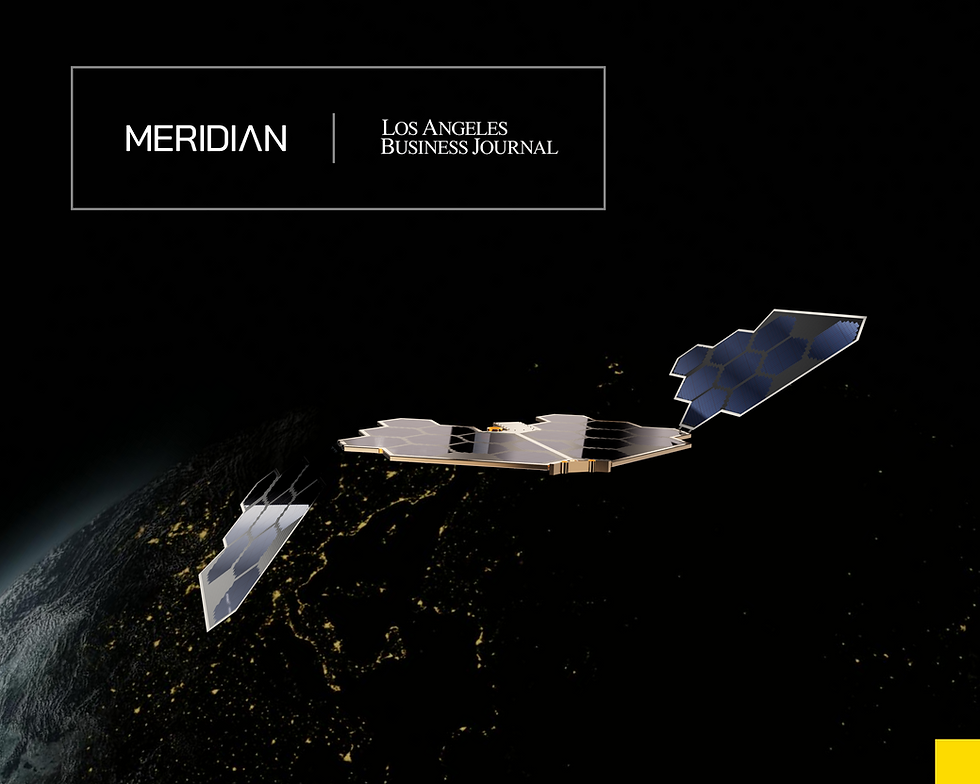
SpinLaunch Lands $30 Million
Long Beach-based SpinLaunch lands $30 million in a series C round that will support its satellite development. SpinLaunch, the Long Beach-based space technology company focused on developing a broadband constellation, announced in mid-August it raised $30 million in fresh funding for its series C round. The new influx of cash comes in part from a previously announced $12 million investment from Kongsberg Defence & Aerospace, as well as another $18 million from existing investors such as leading funder ATW Partners. The funding will be used to bolster the development of the Meridian Space constellation, a satellite broadband constellation that will be deployed in low-earth orbit. SpinLaunch announced the constellation in April, along with its capital infusion from Kongsberg. The goal of the constellation is to operate just as well as its competitors, but at a lower cost. More efficiency and scale One way to achieve that low cost, according to SpinLaunch, is the multi-band reflectarray antenna that was developed by the company. The proprietary antenna was designed to be more compact, energy-efficient and scalable than traditional satellite antennas, and recently completed full-scale testing. “Validating our reconfigurable reflectarray antenna through full-scale testing confirms we can deliver multi-band capability without the cost and complexity of traditional designs,” David Wrenn, the chief innovation officer at SpinLaunch, said in a statement. “This is a critical step toward the development of the Meridian Space constellation and achieving both our technical and operational objectives.” Before the Meridian Space constellation, SpinLaunch was known for designing launch systems that could do away with the first stage of a conventional launch vehicle by relying on a centrifuge to send small payloads into space in a faster, more scalable way. That technology inherently gave way to its constellation project – one that could handle its centrifuge.
Aug 20, 2025

What SpinLaunch Is Doing With Its $30M Series C
Renders of the Meridian Space satellite with its solar panels stowed. SpinLaunch closed $18M in new funding to develop a LEO satellite broadband constellation, called Meridian Space, bringing the company’s total Series C round to $30M. While SpinLaunch is best known for its kinetic launch technology, which aims to use centrifugal acceleration to send satellites to orbit, the plan is to deploy the constellation from traditional rockets—at least in the short term. Longtime investor ATW Partners led the Series C, which includes a $12M investment from Kongsberg Defence & Aerospace. The company has raised $203M to date, according to SpinLaunch. Pivotal distinction: The push to develop a global satcom constellation does not signal a fundamental pivot in the long-term vision of the company, according to CEO Massimiliano Ladovaz. “The priority currently is on the constellation, but the team is still working on the launcher,” Ladovaz told Payload. “It’s all about designing satellites that are compatible with the launcher and build[ing] them. That’s the reason why the team found, and worked on, this completely different technology.” In an effort to take advantage of SpinLaunch’s unique launch system, which is designed to launch smaller payloads in rapid succession, the company started working on a smaller comms satellite in 2020. The result is a spacecraft that aims to be small and robust enough to withstand the high G-forces of SpinLaunch’s launch system once it’s fully operational. It uses a reflectarray antenna technology—first demonstrated in space by NASA’s JPL in 2018—but with an upgraded design to offer similar performance of traditional satcom antennas using a fraction of the power. Meridian sats will weigh just 70kg, meaning a constellation of 250 sats capable of offering global coverage can be launched on a single rocket. SpinLaunch plans to deploy these satellites in fixed-track orbits, simplifying the ground station architecture, and allowing for connections to cheaper user terminals that don’t have to search for a signal. The benefits of the Meridian constellation are unlike anything Ladovaz—who joined SpinLaunch in June after decades working at SES, Inmarsat, and Eutelsat/OneWeb—had ever seen. “LEO is very, very hard; very, very expensive…[but] I quickly realized that this was a game changer.” Ladovaz said. “It’s not anymore a multi-billion-dollar system.” Spinning up: SpinLaunch plans to continue testing its reflectarray antenna during the coming months. It has contracted Kongsberg NanoAvionics to build over 280 sats. SpinLaunch also has an agreement with an undisclosed launcher to fly its first antenna to demonstrate a customer link by the end of 2026. From there, the company aims to deploy its first constellation of 30 sats in an equatorial orbit in late 2027, and then another 250 sats to offer global coverage by 2030. While the first equatorial constellation will offer 300 gigabits per second of connectivity, SpinLaunch expects the full global constellation to reach two terabits per second—or about twice the capacity of the OneWeb first-gen constellation, Ladovaz said.
Aug 18, 2025

SpinLaunch raises $30 million for work on Meridian Space constellation
SpinLaunch plans to develop a broadband constellation called Meridian Space using satellites built by Kongsberg NanoAvionics. WASHINGTON — SpinLaunch announced $30 million in new funding for the company to support its development of a broadband constellation. SpinLaunch said Aug. 18 that it closed $30 million in funding existing investors, led by ATW Partners. That amount includes a $12 million strategic investment from Kongsberg Defence and Aerospace announced in April. The funds will support continued development of Meridian Space, a broadband constellation that SpinLaunch revealed in April at the same time as its agreement with Kongsberg. That agreement included a contract awarded by SpinLaunch to Kongsberg subsidiary Kongsberg NanoAvionics worth 122.5 million euros ($143 million) for 280 satellites. Prior to the April announcement, SpinLaunch was best known as a startup developing an alternative launch system that used a centrifuge to accelerate vehicles to hypersonic speeds, effectively replacing the first stage of a conventional launch vehicle. The company, though, had been working behind the scenes on a constellation for several years. The company is now focusing much more on Meridian Space. SpinLaunch announced in July it hired Massimiliano Ladovaz, former chief technology officer of OneWeb and chief operating officer of Eutelsat, as its new chief executive. David Wrenn, who had been chief executive of SpinLaunch, moved into a new position as chief innovation officer. “I thought I was done with LEO,” Ladovaz said in a recent social media post. “I truly enjoyed building OneWeb, but let’s be honest: deploying a LEO constellation is incredibly hard. I had planned to move on and focus on something new.” What lured him to SpinLaunch and its Meridian Space system, he wrote, was “a new kind of LEO technology and architecture” that offered far lower deployment costs than other constellations. “What if we could deploy a global LEO constellation at the cost of a GEO system? Impossible? Maybe not.” A key element of that architecture is a proprietary multi-band reflectarray antenna that SpinLaunch claims is far more cost-effective than traditional satellite designs, although the company has released few details to support that claim. SpinLaunch said it recently completed testing of that antenna. “Validating our reconfigurable reflectarray antenna through full-scale testing confirms we can deliver multi-band capability without the cost and complexity of traditional designs,” Wrenn said in a statement. “This is a critical step toward the development of the Meridian Space constellation and achieving both our technical and operational objectives.” The new funding, the company told SpaceNews, will support effort to validate new technologies needed for the system and accelerate “go-to-market activities”. The announcement of the new funding said nothing about SpinLaunch’s efforts to develop an orbital launch system. The company, which built a subscale centrifuge at Spaceport America in New Mexico for suborbital tests, said in April it signed an agreement to lease land on Adak Island in Alaska’s Aleutian island chain to host the larger centrifuge needed for the orbital launch system. Wrenn, in an interview in April when he was chief executive, said efforts to build the orbital launch system were still in an “exploratory phase” at the time, and predicted it would take several years to develop.
Apr 2, 2025

SpinLaunch Plans LEO Broadband Constellation, Built by Kongsberg NanoAvionics
SpinLaunch, the startup developing a steel vacuum chamber to launch satellites to space, is also pursuing a Low-Earth Orbit (LEO) broadband constellation. SpinLaunch, based in Long Beach, California, announced plans for a LEO constellation called Meridian Space on Thursday. The constellation is backed by a $12 million investment from Norwegian defense firm Kongsberg Defence and Aerospace. Kongsberg NanoAvionics will build 280 satellites for the initial constellation in a contract that NanoAvionics said is valued at 122.5 million euros ($135 million). This is the NanoAvionics’ largest order to date. An in-orbit demonstration mission planned for 2026 will host Meridian’s communications payload onboard NanoAvionics’ standard MP42 microsatellite bus. The company plans for a future constellation of 1,190 high-throughput satellites, referencing 2021 spectrum fillings. SpinLaunch filed a request in the FCC’s V-band processing round in 2021. SpinLaunch claims it can provide “global coverage with only one traditional rocket launch deploying 250 next-generation microsatellites,” indicating it plans to deploy the constellation via traditional launch instead of its own steel vacuum chamber method. The company said it “remains committed” to advancing the kinetic launch system. “SpinLaunch was founded on a bold commitment to deliver a more sustainable, cost-effective approach to launching satellite constellations – a vision that logically involved considering our own global network from the outset,” said David Wrenn, CEO of SpinLaunch. “We are now excited to officially bring our low-cost, dynamic communications service to enterprise customers worldwide.” NanoAvionics and SpinLaunch plan to co-develop a tailored satellite that weighs approximately 70 kilograms each, designed to be lighter than currently operational satcom platforms. Describing the technology, SpinLaunch said the satellites will feature an “ultra-efficient reflectarray antenna technology [that] lowers satellite mass and size.” Sev Sandomirsky, SpinLaunch director of Satellite programs, explained some of the underlying technology in a video about the constellation. “The thing that makes our payload unique is that it is both a reflect array and a bent pipe,” Sandomirsky said. “[This] means that it is a low-power, beam steering antenna, as opposed to a direct radiating phased array that uses much more power and is much more complex. SpinLaunch also said the constellation will have a “unique orbital architecture featuring a repeating ground track simplifies user terminals and gateways by eliminating the need for expensive 2D scanning antennas.”
All
Press Release
Media Coverage
Meridian Space Successfully Activates its First Communications Payload in Orbit
Milestone marks the culmination of five years of proprietary antenna development and establishes the foundation for Meridian's next-generation LEO networks. LONG BEACH, Calif., October 2nd, 2026 – Meridian Space, the space infrastructure company enabling governments and commercial organizations to own and control their own low Earth orbit (LEO) satellite networks, today announced the successful initial activation of its first communications payload in orbit. Launched aboard SpaceX's Transporter-18 mission from Vandenberg Space Force Base on October 1, Meridian's First Customer Link (FCL) mission represents the company's first deployment of its novel reflectarray antenna technology in space, following five years of development, engineering and qualification. At the heart of FCL is Meridian's lightweight, electronically reconfigurable reflectarray antenna, designed to deliver high-performance communications while significantly reducing satellite mass and power requirements. The technology enables smaller, more efficient satellites, reducing the cost and complexity of establishing dedicated LEO networks and making satellite ownership more accessible to governments and commercial organizations. "Seeing our technology successfully deployed and powered on in orbit is a tremendous achievement for Meridian and our team," said Massimiliano Ladovaz, CEO of Meridian Space. "But what excites me most is what comes next. We're building a fundamentally different model for satellite connectivity, one where customers own their networks rather than lease capacity from someone else. This is the milestone that makes the vision a commercial reality." Beyond its initial commissioning, FCL will support early customer demonstrations and trials. The mission is designed to support downlink speeds of up to 1.1 Gbps and will enable Meridian to validate the critical communications technologies underpinning its commercial satellite systems, including its proprietary antenna technology, payload operations and ground infrastructure. The first communications link using Meridian's proprietary payload is planned for the coming weeks. The FCL mission carries Meridian's proprietary communications payload aboard Kongsberg NanoAvionics' MP42 satellite platform. Additional details about the spacecraft platform are available in NanoAvionics' press release. The technologies being validated through FCL will underpin two complementary offerings: Meridian Express and Meridian's next-generation LEO constellation architecture. Meridian Express is a standardized, rapidly deployable constellation offering designed for commercial and defense applications, particularly in critical environments where secure, dedicated communications infrastructure must be established quickly. Building on the communications technology being validated through FCL, Meridian Express provides customers with a faster, more accessible path to owning and operating dedicated LEO networks, with satellite deliveries expected to begin in 2027. For customers requiring larger-scale networks, Meridian is developing its baseline constellation architecture, designed to deliver high-capacity broadband connectivity through purpose-built, customer-owned satellite infrastructure. Leveraging the same core communications technology being validated through FCL, the system's compact satellite design enables significantly more satellites to be accommodated on each launch, reducing deployment costs and the number of launches required to establish a constellation. Watch Meridian Space CEO, Massimiliano Ladovaz, as he introduces Meridian Space and why it is a game changer in LEO satellite communications.
Press Release
|
Oct 2, 2026
Meridian Space to Separate SpinLaunch Business Ahead of First Satellite Launch
Meridian Space is separating SpinLaunch into an independent company, while Meridian will maintain its focus on its broadband constellation plans. This comes as Meridian will launch its first satellite to test its technology in-orbit on the SpaceX Transporter-18 mission, set to launch on Thursday. A Meridian Space spokesperson confirmed the plans to Via Satellite this week. The company is building a team to shape SpinLaunch’s strategy and will share more details about its leadership and plans in the future, the spokesperson said. SpinLaunch is not for sale. “SpinLaunch is entering its next chapter with a renewed focus on advancing and commercializing its kinetic launch technology. SpinLaunch will continue to build on its vision for a lower-cost approach to launch, with further applications in hypersonics to support the Golden Dome program and in the lunar economy,” the spokesperson said. SpinLaunch began in 2014 to develop a kinetic launch system that uses a ground-based accelerator designed to launch rockets to orbit. Last year, SpinLaunch announced plans to develop a Low-Earth Orbit (LEO) broadband constellation, tapping former OneWeb exec Massimiliano Ladovaz to lead the company. First Customer Link Demo On Thursday, Meridian is set to see its first satellite, known as First Customer Link, launch on the SpaceX Transporter-18 rideshare mission. Kongsberg NanoAvionics built the bus for the satellite. Ladovaz recently told Via Satellite that Meridian has customers for this demonstration satellite and will perform testing with its first ground site in France, and at a Miami site of its digital infrastructure partner Equinx. “There are not many assets like ours in space available for testing,” Ladovaz said. “Our architecture is a transparent architecture that allows you to test every waveform you want. That adds a lot of interest for some customers to test different types of [waveforms] from commercial commercial waveforms to defense waveforms over a LEO system — and that’s because our architecture allows it.” Ladovaz said the company is in “advanced discussions” with both commercial and government customers for the Meridian constellation. The company’s business model is built on ownership and control, where a single customer like a sovereign government or a regional operator can afford full ownership of a constellation, or fractional ownership. While Meridian was originally planned as a flat satellite design, the company is also offering “Meridian Express,” based on the FCL satellite, which is not a flatsat design but can be deployed more rapidly. The company has offers out to deliver a smaller constellation next year, he said. “Customer are coming to us and asking — can we launch next year? It’s clear people can’t wait for 2032, 2035 to get their constellation up,” he said. “That’s where Meridian comes in. Meridian is lower CapEx, fewer launch vehicles, but it’s also about scaling assurance.”
press release
|
Sep 29, 2026
Exclusive: Meridian Space Spins Out from SpinLaunch
SpinLaunch, the CA-based startup best known for its development of a kinetic launch system, has been working on satcom technology since 2020—under a unit later called Meridian Space. As of today, those business lines are going their separate ways. “SpinLaunch and Meridian Space are separating into two independent companies,” Meridian Space CEO Massimiliano Ladovaz told Payload. “Meridian will carry forward the satcom infrastructure business…SpinLaunch will continue to build on its vision for a lower-cost approach to launch, with further applications in hypersonics to support the Golden Dome program and in the lunar economy.” Call me maybe: The split comes just weeks before Meridian’s first in-space demo, which is expected to launch on SpaceX’s Transporter-18 rideshare NET Oct. 1. The sat aims to demonstrate the first customer link of Meridian’s in-house-developed reflect-array technology, which company officials say uses less power than existing satcom payloads. With less power and space needed to operate and house the antenna, Meridian officials believe the company can fly satellites that are lighter and smaller than other satcom sats in the market—and pass those savings onto customers. “Power is the thing that you want to preserve in space,” Ladovaz told Payload. “[If] you can deliver very high capacity, very flexibly, at a fraction of the power…then the satellites can be very small, and therefore, you can launch them in fewer launches.” Meridian’s long-term goal is to fly its reflect-array antenna on flat satellite buses, making the deployment of a full 250+-sat-constellation possible on just one dedicated launch. In the shorter term, however, Meridian is offering customers the ability to fly the payload on traditional cubesat buses—under a program called Meridian Express, which could be ready to launch next year. Go fast, go alone: Meridian is actively working on signing its first customers, according to Ladovaz. The company is targeting sovereign governments, regional operators, and telecom companies who want to own and operate a satcom network independently. At a time when those wanting to own their own satcom networks are forced to either sign on to global networks like SpaceX Starlink or Amazon Leo, or spend potentially billions to build their own, Meridian aims to offer customers a third path. Meridian’s technology is designed to be built easily by partners. So while Meridian has signed a deal to build its first batch of sats on NanoAvionics buses, the tech opens the door for sovereign-satcom systems to be built in any country a future customer might want. “This is about ownership, control, and the fact that we sell custom-made systems to customers,” Ladovaz told Payload. “We can build a system for less than a billion dollars. That includes the space segment, launch, and ground.” To the Moon: SpinLaunch will share more details about its “leadership, vision, and plans in the near future,” according to Ladovaz. However, the company was awarded a patent last year—covering a kinetic launcher “anchored on to a planetary body with a rarified atmosphere…”—suggesting SpinLaunch’s future may lie off-world, sending payloads from the Moon back to Earth, or further into deep space.
media coverage
|
Sep 28, 2026
Meridian Space splits from SpinLaunch to pursue broadband constellation plans
TAMPA, Fla. — Meridian Space has split from kinetic launch technology developer SpinLaunch as it seeks more funding to develop flat satellites it says could launch up to 250 at a time on a Falcon 9, enough for global broadband coverage. “SpinLaunch and Meridian are separating into two independent companies, each with a distinct focus and its own path forward,” Meridian said in a statement to media. “Meridian will carry forward the satcom infrastructure business which it has actively developed for the past several years. SpinLaunch is entering its next chapter with a renewed focus on advancing and commercializing its kinetic launch technology.” The corporate split became official Sept. 21, according to a Meridian spokesperson. SpinLaunch will continue developing an alternative launch system that has involved using a centrifuge to accelerate vehicles to hypersonic speeds to effectively replace a conventional rocket’s first stage, the spokesperson said, while also pursuing hypersonics technologies to support the U.S. Golden Dome missile defense program. SpinLaunch is also exploring applications for its technology in a future lunar economy. “The company has been assembling a dedicated team around the mission who are shaping SpinLaunch’s strategy and priorities, and will be sharing more about its leadership, vision, and plans in the near future,” the Meridian spokesperson added. Last year, SpinLaunch announced it had raised $30 million in a funding round led by ATW Partners to help build out a broadband constellation, including a $12 million investment from Norway’s Kongsberg Defence and Aerospace. NanoAvionics, Kongsberg’s Lithuanian small satellite manufacturing unit, has signed a 122.5 million euro ($139 million) contract to deliver 280 satellites for Meridian. Massimiliano Ladovaz, the former chief technology officer of OneWeb, joined as Meridian’s CEO a few months later. Meridian’s aim to develop 70-kilogram satellites that, when stowed for launch, would be less than two meters wide, a little over a meter and a half tall and 30-40 centimeters thick hinges on a low-profile antenna slated to fly on SpaceX’s next rideshare mission Oct. 1. The antenna has been integrated with a standard cubesat from NanoAvionics to test a capability Ladovaz says would enable the thin satellite version to deliver “very high capacity, similar to any other broadband satellite,” while being 20 times more power efficient than legacy satellites in low Earth orbit (LEO). “There’s an advantage to not being first: you can look at everything that was done before,” Ladovaz told SpaceNews via email. “The team looked at the LEO constellations already being built and asked where the cost and complexity were coming from. One answer was the payload. By developing a high-performance, low-power antenna, we can build much smaller satellites.” According to Meridian, this reduces the capital needed for a constellation, along with the number of rockets needed to put it in orbit, as SpaceX’s shift from its Falcon 9 workhorse to Starship development looks set to worsen an already constrained supply for launch capacity. “This is now even more relevant as SpaceX looks to reduce the number of launches it makes available,” Ladovaz added. “We designed the technology to address the cost, but it now also helps address a challenging launch market.”
media coverage
|
Sep 27, 2026
SpinLaunch Selects Equinix to Deploy Global Ground Infrastructure for Meridian Space Constellation
Equinix’s global data center footprint solves key challenge in LEO gateway deployment, delivers secure, low-latency integration for enterprise and cloud customers Unlike traditional LEO systems that require complex and expensive gateway antennas deployed at greenfield sites, SpinLaunch’s unique fixed-track orbital architecture enables the use of lightweight and efficient 1D scanning toroidal antennas, significantly reducing the size, weight, and power requirements of gateway sites. Each SpinLaunch teleport occupies a footprint of roughly 90 square meters, a fraction of the size of conventional ground stations. This breakthrough results in easily deployed teleports at rooftops, data centers, and other existing sites, unlocking fast, flexible, and cost-efficient scaling of the ground segment. “Selecting Equinix as the foundation for our global ground segment marks a critical milestone for SpinLaunch,” said Massi Ladovaz, CEO of SpinLaunch. “By working with Equinix, we’ve solved a core challenge in deploying global LEO infrastructure: securing scalable, reliable gateway sites across key regions – by placing our teleports directly within the world’s most connected data center ecosystem. It also brings real value to our customers by enabling secure, sovereign data pathways and seamless integration with enterprise and cloud networks - a foundational step toward a more resilient and connected satcom ecosystem.” By co-locating teleports at Equinix facilities, SpinLaunch extends satellite connectivity directly into secure, high-performance environments where enterprises already operate their digital infrastructure. This eliminates the need for separate ground systems or complex backhaul, enabling seamless access to the Meridian network through existing cloud and data platforms. The result is faster service delivery, lower total cost of ownership, and stronger control over data security and sovereignty - critical advantages for enterprise, telecom, and government users. SpinLaunch has already begun the selection process for its inaugural teleport, where a gateway will be installed to connect its First Customer Link (FCL) satellite. This site will serve as a demonstration of SpinLaunch’s gateway technology and establish a reference architecture for future global expansion.
press release
|
Apr 29, 2026
SpinLaunch Introduces Meridian Defense, a Purpose-Built LEO Constellation for Secure and Sovereign Communications
Integrating space-based routing, secure architecture, and mission-aligned controls to enable sovereignty for governments worldwide. Meridian Defense builds on the core technology of SpinLaunch’s Meridian constellation, leveraging the same breakthrough advances in satellite design, orbital architecture, and system efficiency. The result is a fundamentally different approach to defense communications - one that combines high performance with significantly lower cost and faster deployment timelines. As governments increasingly prioritize sovereignty, security, operational agility, and resilience in space-based communications, Meridian Defense is designed to provide greater control over data, infrastructure, and operations, while reducing reliance on complex and geographically distributed ground networks. The system architecture enables secure, end-to-end communications across global theaters by routing data through space, reducing reliance on ground relay points and improving resilience in contested and denied environments. Combined with a simplified ground segment and scalable deployment model, Meridian Defense delivers operational flexibility and mission assurance. “Governments are looking for more than just capacity - they are looking for control, resilience, and the ability to deploy systems on their own terms, in contested environments,” said Massi Ladovaz, CEO of SpinLaunch. “Meridian Defense is a direct response to those needs. It builds on the same core foundations as Meridian, but is purpose-built as a defense system, allowing us to deliver secure, high-performance communications at a fraction of the cost, timeline, and complexity of traditional architectures.” “Designing for defense means assuring communications access to users in physically and electromagnetically challenged environments, while remaining cost-effective as a key element of a diverse network strategy,” said Peter Hadinger, Board Advisor at SpinLaunch and former President, U.S. Government and Chief Technology Officer at Inmarsat. “Meridian Defense is being designed to provide governments with an independent and trusted national system that their mission-critical users can depend upon.” Meridian Defense is designed to support a range of mission-critical applications, including secure communications, tactical connectivity, and resilient network operations in contested environments. Its architecture is inherently adaptable, enabling governments to deploy systems aligned with national security requirements and evolving operational needs. SpinLaunch is actively engaging with government and defense stakeholders globally to further define deployment models and mission profiles for Meridian Defense.
press release
|
Apr 29, 2026
10 Hottest Companies in Satellite for 2026
Via Satellite's annual list of the 10 Hottest Companies in Satellite
View Here Via Satellite’s annual 10 Hottest Companies rounds up 10 “must watch” companies in the satellite industry, from constellations, manufacturing, launch, and more. Via Satellite editors chose the companies on this list based on their expected activity for the year, and a mix of market share, transformational technology, ground-breaking deals, and overall industry excitement. Since 2019, the annual list has highlighted more than 70 companies. The companies selected as the 2026 10 Hottest Companies in Satellite are listed here in alphabetical order: AIRBUS/LEONARDO/THALES SPACE MERGER Europe is a growing hotspot for space investment as governments realize they need more locally developed tech going forward. Airbus, Leonardo, and Thales signed a memorandum of understanding (MoU) late last year to create a leading European player in space and bring their space businesses together. The combined entity will employ around 25,000 people across Europe. This merger gives Europe a player with immense size and scale that can compete in many markets and far more on a global stage than ever before. Carla Filotico, partner and managing director of Novaspace, called it a “bold and necessary move,” and she said the new company can create “scale, coherence and speed.” The move represents a new era when it comes to European space. Europe has many space companies, but none with this level of scale. This new company should help with sovereign strategies across Europe and the new company can play a key role in fostering innovation across the continent. While this new company will be a large player, maintaining agility will be essential. Can it develop new products and solutions at speed? Can it work with European startups and help power the overall European space ecosystem and strengthen European space supply chains? Can it keep pace with the likes of SpaceX and Amazon on a global stage or will it be slow to react to the fast evolutions in the global space market? There are many questions but there is no doubt the eyes of the satellite world will be on this new company. It could be the catalyst for Europe to realize its overall potential. It can help future-proof the industry, as well as play a key role in the defense of Europe. Whatever the future holds, it will be one of the most talked about space companies in the second half of the 2020s. ARKEDGE SPACE Japan has a rich history in space and ArkEdge Space is one of the latest Japanese space startups to have a huge impact. The company, which looks to build and mass-produce micro-satellite constellations is creating quite a buzz and regular features on space startup lists. 2025 was another big year for the company, as ArkEdge Space raised $52 million in a Series B funding round. In February, ArkEdge Space linked up with SKY Perfect JSAT to accelerate the commercialization of micro-satellite constellations in a major collaboration. ArkEdge will tap into Sky Perfect JSAT’s expertise in satellite operations to create a more efficient and reliable mission control system. It formed other exciting partnerships in 2025. It also teamed up with Kongsberg Satellite Services (KSAT), a player in ground segment and satellite operations services, to establish a strategic partnership in the microsatellite sector. With the demand for small satellites on the rise, ArkEdge is aiming to be a leader in building and producing micro-satellites. However, its biggest news perhaps came at the end of the year when it announced the successful launch and initial checkout of its three satellites AE5Ra, AE5Rb, and AE5Rc. With this mission, the number of in-house developed and operated satellites has reached 12. ArkEdge Space then confirmed communications using test signals via its own ground stations. The company was founded in 2018, and then changed its name to ArkEdge Space in 2021. It has had a meteoric rise and is working across the world in countries such as Paraguay, Brazil, Kyrgyzstan and Tajikistan, among others. It also has a strong relationship with JAXA and has been selected for various initiatives with the space agency. It could be the next big thing to come out of Japan’s space sector. FARCAST The antenna market is one of the most important in satellite as these pieces of hardware are vital for successful operator strategies. It is full of world-class players, and another one may be about to emerge. Farcast, a San-Francisco-based startup, made quite a splash in 2025 with some of the biggest players in space backing the company and its technology. In November, Telesat was the latest big name to give its backing to this new antenna upstart. Farcast is developing a technology that can simultaneously transmit and receive data from the same aperture in a flat panel antenna (FPA). This proprietary active electronically scanned antenna (AESA) technology uses electronic beam scanning, and the single-aperture, full-duplex FPA results in reduced size, weight, power, and cost (SWaP-C). Telesat made a $5 million equity investment in Farcast, and their partnership will see Farcast develop an enterprise-class FPA user terminal that is fully integrated with the Telesat Lightspeed modem. Yet Telesat was not the only big name to cast its eyes towards Farcast. In December, Gogo also made a strategic investment in Farcast to fund the development of aviation user terminals. Earlier in the year, Lockheed Martin also invested $2 million into Farcast. It is a company on the rise, and one that has made some big noise considering it is a new player in the block. It operates in a very competitive part of the market. The backing from the likes of Telesat, Gogo, and Lockheed Martin seems to indicate that Farcast is one to watch. IONQ IonQ caught the attention of the space industry in July last year when it finalized a deal to acquire Capella Space, a U.S. space tech company with synthetic aperture radar (SAR) assets. IonQ might be one of the most ambitious companies from a tech perspective in space right now. It is aiming to develop what it claims is the world’s first space-to-space and space-to-ground satellite quantum key distribution (QKD) network, enabling quantum-secure global communications. The company made a number of significant acquisitions in the space arena. As well as Capella Space, it also acquired Skyloom Global, a U.S. company in optical communications infrastructure that enables secure, high-speed data links across Earth and in orbit. But, there was more to the company than just its exciting acquisition strategy around quantum and space. In July, it signed an MoU with the U.S. Department of Energy (DOE) to advance the development and deployment of quantum technologies in space. In the first half of 2025, it also linked up Intellian Technologies, a well-known ground segment company in the satellite sector, to explore how secure quantum networking can transform satellite communications. The dealflow across 2025 was significant with acquisitions and partnerships aplenty as IonQ showcased its ambition to become one of the biggest players in quantum and space, a relatively new area of the market. The company has also seen rapid revenue growth over the last few years. With quantum computing becoming one of the next big things, IonQ is in a strong position to realize the potential of expanding quantum networks to space. With some huge acquisitions in 2025, the company is set for another pivotal year as it looks to merge space and quantum technologies together. LYNK/OMNISPACE The pending Lynk and Omnispace merger brings together valuable assets and experience in the direct-to-device market that could see the two companies be much stronger together than they were separately. Both were early leaders in reimagining satellite connectivity’s role in the telco ecosystem. Lynk was the first to demonstrate a text message sent from a satellite in Low-Earth Orbit (LEO) to a mobile phone on Earth in 2020. Similarly, Omnispace CEO Ram Viswanathan set out an early vision of satellite being a larger part of 5G networks in a hybrid future. Despite their early successes, neither company so far has been able to move into wide, operational deployment. The merger announced in November will bring together Omnispace’s access to S-band spectrum, with Lynk’s experience building and operating satellites and active partnerships with mobile network operators (MNOs) around the world. Omnispace cites its market access footprint as reaching 1 billion people across the Americas, Europe, Africa and Asia; while Lynk has relationships with more than 50 MNOs. SES is also coming onboard as a strategic investor, and the combined company will benefit from SES’s relationships with telecom and government customers. And the company has a wider vision than just consumer phones — this type of connectivity could be particularly interesting for commercial and industrial vehicles, and government and utility sectors worldwide. Joining together could be the spark that leads Lynk and Omnispace to greater success in the direct-to-device D2D market. PLANET LABS Planet Labs, known for being one of the original ‘New Space’ companies, is particularly ‘hot’ going into 2026 after a banner year in 2025 underpinned by international deal expansion and AI tech integration. The satellite imagery company finds itself at the intersection of AI and geopolitical changes. It's seeing more and more demand for AI-enabled solutions as nations — particularly in Europe — want greater access to satellite imagery. Planet made inroads into the European defense market in 2025 with a $283 million multi-year deal with the German government for satellite imagery and analytics services and a seven-figure contract with NATO to deliver advanced daily monitoring and intelligence capabilities. It is investing in Europe as well, building a new satellite manufacturing facility in Germany for its Pelican satellites. The strength of Planet’s dealflow is shown in recent backlog growth. In its most recent financials, Planet reported $734 million in backlog — up more than 215 percent year-over-year. The company is expected to end its 2026 fiscal year with 22 percent revenue growth. And investors are looking at Planet with fresh eyes — the company’s stock price has increased around 250 percent over the past year. Looking to the future, Planet has its sights on in-orbit computing. Its next-generation “Owl” monitoring satellites will have Nvidia graphics processing units (GPUs) onboard for more advanced onboard computing. At the same time, the company is partnering with Google for a “moonshot” project for in-orbit computing — showing that Planet continues to invest in tech innovation. SERAPHIM SPACE Seraphim Space has become synonymous with gold standard investing in the satellite sector. To give you an idea of Seraphim Space’s performance, you only have to look at its top four holdings and their outstanding performance in recent times. At the end of September 2025, its investments in Iceye, All.Space, Hawkeye 360 and D-Orbit were worth 192 million pounds ($258.7 million). At the end of December last year, that had increased 36 percent to reach 261 million pounds ($351.7 million). It has backed some of the biggest new success stories in satellite in recent times with the likes of Iceye, D-Orbit, Xona Space Systems, Skylo, Pixxel, and AST SpaceMobile all part of its portfolio. Space finance and investing is a hot topic in itself and Seraphim is at the heart of this ecosystem and is considered an authority when it comes to investments in space. However, the company is not resting on its laurels. In September last year, it announced that it was launching a European subsidiary, Seraphim Space Europe, which will be headquartered in Berlin. The company is looking to tap into the lucrative European security and sovereign defense market. If it can repeat the success of some of its most recent investments, it can continue its meteoric rise. Billions of dollars are now being invested in space companies and investors’ appetites for space show no sign of slowing down. Defense right now is the biggest driver with the geopolitical environment leading to increased spending from governments. A company like Seraphim Space is uniquely positioned to take advantage of this boom. However, finding the next Iceye or the next Hawkeye360 is easier said than done. Seraphim Space has always had a unique place, being one of the first dedicated space VC companies. It has had a very impressive few years, and is growing at a fast clip, showing that financing space companies can indeed be a lucrative business. SPINLAUNCH SpinLaunch, the space startup known for its centrifuge launch concept, seems like an unlikely candidate to shake up the LEO constellation market. Yet its Meridian Space constellation has the potential to be truly disruptive to the economics of LEO. Last year, SpinLaunch hired industry veteran Massimiliano Ladovaz as CEO. Ladovaz brings his experience as OneWeb CTO and experience working at operators SES, Inmarsat, and Eutelsat. He’s clear-eyed about the economic challenges associated with LEO constellations competing with Starlink. SpinLaunch’s approach with Meridian Space is a simple satellite design with a powerful antenna, where an entire constellation can be deployed through a single standard launch. The company says this approach allows for pricing that unlocks opportunities for nations for sovereign solutions and regional operators to have capacity to compete with Starlink. SpinLaunch is working with Kongsberg NanoAvionics to build the first 280 satellites in the initial constellation. The contract was for $135 million, a surprisingly low price for that many satellites, and it came alongside an investment from Kongsberg as well. The company reports it has completed antenna and payload testing milestones and it is preparing to launch the first satellite on Transporter-18. SpinLaunch is rethinking the LEO constellation in a disruptive way. VIASAT Viasat is embarking on a new era with the Inmarsat integration complete as the company prepares to finally realize the capacity of the ViaSat-3 constellation. While the failure of the first ViaSat-3 satellite was a setback at a critical time of industry change, Viasat is now on firmer footing as the second satellite is en route to final orbital position, and the third satellite is nearing launch. Just one of these satellites will double the capacity of Viasat’s entire network, and both will bring more capacity to support its growing business in aviation and government satcom and bolster its position in maritime and fixed broadband. Investors are looking at Viasat with fresh eyes as the company’s stock price soared 300 percent over the past year. Part of this was driven by momentum and attention on the company’s defense segment. Viasat was smart to restructure its segments in 2024 because the change showed the value of its defense technology portfolio, which includes encryption, cybersecurity, and tactical gateways. It took an activist investor pointing out that Viasat’s valuation wasn’t reflecting the strength of its defense portfolio for investors to take notice. The company’s stock has climbed from less than $10 a share last year to around $40 a share today, and the company is generating free cash flow. Viasat is also staking out an interesting position in the direct-to-device landscape with Mark Dankberg’s leadership in the Mobile Satellite Services Association and Equatys, which is pitching a shared infrastructure approach to direct-to-device as a counter to large players like Starlink. At the same time, its work with 5GAA on automotive connectivity is compelling. Viasat has always been a tech leader in the satellite arena, and now is embarking on a new chapter post-Inmarsat acquisition fueled by new capacity and investments in defense and D2D. VOYAGER TECHNOLOGIES After a massive 2025, Voyager Technologies is in an interesting position going into 2026 and beyond. Last year, the company raised $383 million in an initial public offering, and rebranded from Voyager Space to Voyager Technologies to emphasize its role in national security. At the same time, it went on an acquisition spree, acquiring capabilities in radar analytics with ElectroMagnetic Systems; electric propulsion with Exoterra; optical communications through BridgeComm; solid rocket motors with Estes Energetics; and star trackers through Optical Physics. These acquisitions strengthen its vertical technology stack and put Voyager Technologies on more government contracts. And there’s no plans of stopping — company leadership has said that Voyager continues to pursue strategic M&A. These acquisitions raise the question — What is Voyager building? It will be interesting to see how these capabilities and its defense focus complements the work on the Starlab commercial space station. Starlab is one of the commercial space stations in the running to serve as future home of human presence in Low-Earth Orbit (LEO) when the ISS is retired. Voyager is in a joint venture with Airbus, Mitsubishi Corporation, MDA Space, Palantir Technologies, and Space Applications Services, called Starlab Space. Between its commercial space station and a wide range of capabilities, Voyager Technologies could define a new category of space prime.
Via satellite
|
Feb 22, 2026
SpinLaunch Appoints Former Kymeta CEO Walter Berger to Advisory Board to Support Growth of Meridian LEO Constellation
Satcom industry veteran, Walter Berger, to guide strategic initiatives and long-term growth as Meridian advances toward first satellite deployment. SpinLaunch, a pioneer of disruptive space solutions, today announced the appointment of Walter Berger, a senior technology and communications executive with extensive board and operating experience, to its Advisory Board. Berger brings more than 40 years of global leadership across satellite communications, advanced networking, and enterprise technology platforms, with a strong track record of guiding emerging technologies from product validation through scaled market adoption. As President and Co-CEO of Kymeta Corporation, Berger led the launch of the first commercially successful metamaterial flat-panel satellite antenna and multiple first-to-market products. Under his leadership, Kymeta established itself as a leading provider of electronically steered satellite communications solutions adopted by the Department of Defense, as well as government, enterprise, and maritime customers worldwide. He has also held senior executive roles at AppDynamics (acquired by Cisco), SoftLayer (acquired by IBM), and Leap Wireless (acquired by AT&T), including its subsidiary Cricket Wireless. “Walter has operated at the intersection of technology, capital, and market execution for decades,” said Massi Ladovaz, CEO of SpinLaunch. “As we continue to scale Meridian, his experience commercializing advanced satellite technologies and guiding strategic growth initiatives will reinforce our execution as we build momentum with customers and partners.” In addition to his prior operating roles, Berger currently serves as Executive Chairman of AURA Network Systems, a provider of advanced aviation command-and-control communications, and as an advisory board member of Harmoni Towers, an owner and operator of mission-critical communications infrastructure. “What drew me to SpinLaunch is the opportunity to build a truly differentiated LEO satellite system with sovereign relevance and compelling economics – a unique combination in today’s market,” said Berger. “The pace and rigor with which the team has advanced Meridian speaks volumes about their technical discipline and execution focus, and I’m excited to work with Massi and the team as they move toward initial customer deployments.” SpinLaunch has recently completed critical antenna and payload testing milestones for the Meridian constellation and is now preparing for its First Customer Link, scheduled to launch aboard SpaceX Transporter-18 in October 2026. The mission will validate end-to-end system performance ahead of initial customer deployments and broader service rollout. Berger’s appointment builds on SpinLaunch’s recent expansion of its Advisory Board, including the addition of aerospace pioneer and investor Dómhnal Slattery and satellite communications and defense veteran Peter Hadinger. Together, these appointments reflect SpinLaunch’s continued focus on assembling deep expertise across aerospace finance, secure satellite systems, and national-level communications as the company scales the Meridian constellation.
press release
|
Feb 2, 2026
Rethinking the LEO Constellation: Massimiliano Ladovaz on SpinLaunch's Plans for Meridian Space
When SpinLaunch announced plans in April of this year to deploy Low-Earth Orbit (LEO) constellation Meridian Space, it raised eyebrows across the satellite industry. Why is the nonconventional launch startup going after broadband? It only got more interesting when SpinLaunch brought industry veteran Massimiliano Ladovaz on board as CEO over the summer. The former CTO of OneWeb, Ladovaz led deployment of the constellation and then served as COO of Eutelsat/OneWeb Group, and has previous experience with SES and Inmarsat as well. In this interview, Ladovaz explains his decision to join SpinLaunch and how the constellation fundamentally rethinks the economics of LEO. SpinLaunch is working with Kongsberg NanoAvionics on the constellation and recently announced that it completed a design review for the first customer link satellite, set to fly in October 2026. VIA SATELLITE: What drew you to join SpinLaunch and Meridian Space? Ladovaz: My story is quite interesting. I got a call for the CEO search and honestly at the beginning I said, ‘I’m not interested, I don't want to do another LEO constellation.’ I loved OneWeb, it was a fantastic experience — but another LEO constellation? LEOs have one fundamental issue, that's CapEx. It’s very expensive on top of being complicated. The complex side, we can sort that out. But it's the money element that I was not convinced with. LEOs are for rich people, people with big pockets. There’s already Elon, there’s Amazon. But they were insistent. Because I was curious, I looked at it. I started asking more and more questions, we spent quite a few months going into it. Everybody is about vertical integration — the only way to compete with SpaceX is by verticalizing. Yes, it's part of the problem, but good luck competing when Elon is way ahead. The main innovation from the team was the antenna. It’s completely disruptive, it allows you to make the satellite extremely small. We can launch an entire constellation on one traditional launcher. VIA SATELLITE: One traditional launcher, like one Falcon 9? It sounds crazy. Ladovaz: One global system into one launcher. It sounds crazy, but when I looked at the details, I couldn’t find a catch. We’ve tested the antenna. The payload — it’s so simple — it’s just a PCB [printed circuit board] and another piece of electronics. In terms of mass, in terms of cost, it’s a fraction of everybody else. The performance has been demonstrated. We have secured the satellite bus contract with Kongsberg, and the cost of the satellite, the payload, and the launcher is defined. The cost of the space infrastructure is way cheaper than everybody else. VIA SATELLITE: Was this antenna technology developed at SpinLaunch? Ladovaz: The reflector array has been in the literature forever. If you are an antenna expert, you’ve studied reflector arrays. It’s interesting why the SpinLaunch team went in the direction they went. They hired their first satcom team member in 2020. Several years ago, they started working on how to tackle the problem of mass and cost. They took something that was studied in PhDs and books and turned it into a proper, performing solution. The antennas have been tested with NASA successfully and the flight model is supposed to be launched next year. Rendering of a Meridian Space satellite in orbit. Photo: SpinLaunch via Kongsberg NanoAvionics VIA SATELLITE: In the renderings I can see the satellite is primarily an antenna, and a small bus. The contract announcement for $135 million for 280 satellites — that’s not a lot of money for a satellite constellation. What becomes possible in terms of business model at that lower cost? Ladovaz: People that couldn’t afford LEOs can do it, including regional operators, even governments. Governments need sovereign solutions. We hear about the IRIS² 10 billion budget — even governments struggle to find that amount of money. We can provide solutions to sovereign governments or we can be an infrastructure provider to other systems. You see Kongsberg being one of our important shareholders, they are a major defense contractor. They see us being an infrastructure provider to their products. It's not another Starlink, not another OneWeb or Amazon, it’s being completely part of their solutions. They need a telecom system in order to support their infrastructure and that could be one layer of the Meridian constellation. VIA SATELLITE: Do you see Meridian as having fewer customers, but those customers are more invested in the system? Ladovaz: I’ve obviously been in this world quite a bit. The fewer customers, the better. In a good way, because you can then address their needs and it's a clean interface. Ideally, I’d love to sell one entire constellation to a sovereign government. Those discussions are ongoing and are resonating. Or [sell] a fraction of a constellation to a set of regional operators. Regional operators today are in a very difficult position. Even bigger operators are struggling to close a business plan. It’s getting harder. Video is going to stay for a while. But in data, it's harder and harder because Starlink has done a fantastic job. Now distribution partners are switching off GEO [Geostationary Orbit] data communication and turning on LEOs. Data consumption is exploding, but mainly thanks to LEO and customers getting used to low latency. Every app that we use is designed on low latency. Customers don’t care if it comes from GEO or LEO, but they care about the quality of the service. LEO is providing a differentiator. Regional operators could afford to buy LEO with a solution like ours because our system is perhaps the cost of a GEO network. Then it becomes interesting. We might have regional operators — one in Asia, one in South America, or Europe trying to split [a system]. I’ve been an operator. I’ve been on the OneWeb side, Inmarsat, I’ve been at SES. I’ve designed those systems, I know exactly what the cost points are. The struggle in terms of cost — either you go to a massive Starlink-like satellite in order to try to make up your cost per bit. That's what people are trying to do. It’s very difficult to sell that amount of capacity and it’s very difficult to finance. Our solution looks at it differently. Very cheap, scalable. You want more capacity? Launch more of these. That’s why I’m quite excited. VIA SATELLITE: Tell me more about the technology. What spectrum will it operate in? Ladovaz: People are obsessed with the space segment and it’s usually a mistake. It’s true most of the money is usually spent on the space segment. There is an entire element on the ground. Our first system is going to be in Ka-band, but we have spectrum filings in Ku- and Q- and V-band. The same IP we are doing in Ka-band, but we could do it in Ku-band, or any other frequency including low frequency for direct-to-device — but that’s a different conversation. VIA SATELLITE: How does 5G NTN [non-terrestrial network] come into play? Ladovaz: The other thing that as an industry in my opinion we have managed the wrong way is everyone [building] proprietary solutions and closed systems. Everyone has a closed system. I tried with OneWeb to have an open system, but we ended up closed for a number of reasons. At the time, the NTN discussions were not mature enough. But now thanks to AST SpaceMobile, Starlink Direct-to-Cell, the NTN specification and standards are really getting alignment between telecom and satellite. I strongly believe and the idea before I joined SpinLaunch is that our waveform, our solution should be native 5G NTN, as open standard as possible, because we want to be an infrastructure provider. The last thing we want to do is something that’s closed. Ideally, the differentiation will be at a product level, not on the waveform. As long as you have a 5G modem, you could connect to our system. Hopefully everyone is going that direction. This means that our architecture is fully transparent. We could run other waveforms, but our baseline is 5G NTN. VIA SATELLITE: Do you have user terminals in development at this stage? Ladovaz: There is additional IP and differentiation on the ground side. We have some special orbits that are quite interesting because they allow us to drastically reduce the cost of the ground segment. The orbits allow the ground segment to be extremely compact. You could put a gateway in a 1,000 square foot area — this is way smaller than others out there. Having deployed ground, I know how complicated it is to find greenfield. Our gateway could be deployed on the roof of a data center. To be fair, it’s not too different from what SpaceX has been doing, but we believe that our solution is even cheaper. VIA SATELLITE: What do you mean by special orbits? Ladovaz: It's basically a fixed track orbit that has been used in imaging satellites. The satellite comes back to exactly the same point every so many hours. The advantage of that is the user terminals or gateways only have to scan in one direction. In traditional LEOs, the satellite could be in a different direction and it makes it way more complicated. The gateway is nearly as simple as a GEO terminal and extremely cheap. For mobility, I don't want to start investing and building user terminals because there are other people that are very good at that. We provide systems to our customers and they probably have a deployed base they’ve spent millions on terminals. We can connect to virtually any LEO tracking user terminal because of the 5G open architecture. VIA SATELLITE: Starlink has a dominant position in the broadband constellation market, but you think there are ways around that for customers that can't afford Starlink? Ladovaz: Who can’t afford Starlink or don’t want Starlink. Our cost proposition is probably comparable to Starlink. If people just want to go just for super cheap, I suspect they might just keep buying Starlink. Clearly, they are other customers that don’t want Starlink. All those regional operators, it’s a matter of survival unless they become a reseller of Starlink. What is the future, reselling Starlink, or reselling their own products? That’s the question they need to ask. We are providing sovereign solutions to those customers, sovereign governments and regional operators. And for big operators that are trying to tackle Starlink, with us they will have an infrastructure that is way cheaper to what they have today, and they can build their own products on top of it and compete. Unfortunately, the tendency of everyone is to copy Starlink and be vertically integrated. Yes, you can reduce cost, but I think Starlink will still be ahead of everyone in that game. You need to find a different technology base. VIA SATELLITE: We’re talking about Meridian Space, but what about SpinLaunch? What is the latest on the launcher development? Ladovaz: The launcher has been demonstrated 10 times successfully. There is a lot of IP in order to demonstrate that launch. The next step is to fund the bigger, orbital accelerator. The revenues from Meridian will fund the accelerator. The cost of that launcher is again, a fraction of any traditional launcher. Everybody else is trying to copy Elon — good luck. You have to look at the problem in a different way. In terms of steps, first Meridian, then we fund the accelerator. That accelerator has a lot of features on top of cost that are quite interesting for launching constellations. For replacing satellites, you can launch exactly on the orbit you want, and the time to service is practically zero. This being said, we still have some work on it. We are working with some partners. This is one of the largest vacuum chambers in existence, and you know hypersonics is a hot topic. Without getting too into details, people are quite interested in doing some testing and work on that aspect.
Via satellite
|
Dec 1, 2025
SpinLaunch Appoints Aerospace Pioneer Dómhnal Slattery and Defense & Satcom Veteran Peter Hadinger to Advisory Board
Appointments strengthen SpinLaunch’s leadership in defense and sovereign partnerships as the Meridian constellation transitions from development to operational deployment. SpinLaunch, a pioneer of disruptive space solutions, today announced the appointment of aerospace pioneer and investor Dómhnal Slattery and Peter Hadinger, who previously served as Chief Technology Officer and as President, US Government at Inmarsat, to the SpinLaunch Advisory Board. The appointments mark an important milestone in the company’s mission to scale the Meridian constellation - a highly differentiated, low-CAPEX LEO broadband system purpose-built to support defense, government, and sovereign communications. Slattery and Hadinger bring a proven track record across aerospace finance, secure satellite platforms, and national-level communications networks, reinforcing SpinLaunch’s growing role as a trusted partner in resilient, interoperable global satcom infrastructure. “Dómhnal and Peter each bring a remarkable combination of expertise and perspective that will be invaluable as we expand Meridian’s reach across commercial and sovereign markets,” said Massimiliano Ladovaz, CEO of SpinLaunch. “Their experience across aerospace and defense systems, corporate finance, capital raising, and large-scale commercialization will help position Meridian as a cornerstone for secure global connectivity.” Dómhnal Slattery is widely recognized as one of the world’s leading aviation-finance pioneers. As founding CEO of Avolon, he built one of the largest aircraft leasing companies globally with a balance sheet approaching $30 billion. Slattery currently serves as CEO and Chairman of Clahane Capital, as well as Chairman of Vertical Aerospace (NYSE: EVTL), a company electrifying air travel through zero-emissions aircraft. Over the past three decades, the businesses Slattery has built have raised and deployed more than $75 billion to finance aircraft for airlines and aircraft investors around the world. Slattery previously served as Chairman of the SpinLaunch Board of Directors, providing early strategic guidance as the company expanded into satellite communications systems. “I’ve had the privilege of seeing the vision for Meridian from its earliest stages,” said Slattery. “What the team has achieved in such a short time - technically, commercially, and strategically - is a testament to their discipline and credibility. I’m delighted to continue supporting SpinLaunch as it turns that vision into reality.” Peter Hadinger brings more than four decades of technical and executive leadership in satellite communications, defense systems, and advanced space technologies. At Inmarsat, he served as President, US Government and later as corporate CTO, overseeing the company’s global satellite and ground-network development. Earlier in his career, he spent three decades at TRW/Northrop Grumman developing major spacecraft and secure-communications programs. Hadinger has also held key industry leadership roles, helping craft the global Telecom Services Agreement at the WTO and serving as Vice-Chair of both the FCC’s WRC Advisory Committee and the Satellite Task Force for the President’s National Security Telecommunications Advisory Committee. “SpinLaunch represents the kind of innovation that can redefine how resilient and sovereign space infrastructure is built,” said Hadinger. “As defense and government users increasingly depend on assured, adaptable connectivity, the Meridian constellation offers a capable and cost-effective foundation for secure global communications.” Following recent funding and reflectarray antenna validation milestones, SpinLaunch continues to expand its partnerships and capabilities to meet growing global demand for sovereign and defense-grade satellite communications infrastructure.
press release
|
Nov 18, 2025
SpinLaunch Lands $30 Million
Long Beach-based SpinLaunch lands $30 million in a series C round that will support its satellite development. SpinLaunch, the Long Beach-based space technology company focused on developing a broadband constellation, announced in mid-August it raised $30 million in fresh funding for its series C round. The new influx of cash comes in part from a previously announced $12 million investment from Kongsberg Defence & Aerospace, as well as another $18 million from existing investors such as leading funder ATW Partners. The funding will be used to bolster the development of the Meridian Space constellation, a satellite broadband constellation that will be deployed in low-earth orbit. SpinLaunch announced the constellation in April, along with its capital infusion from Kongsberg. The goal of the constellation is to operate just as well as its competitors, but at a lower cost. More efficiency and scale One way to achieve that low cost, according to SpinLaunch, is the multi-band reflectarray antenna that was developed by the company. The proprietary antenna was designed to be more compact, energy-efficient and scalable than traditional satellite antennas, and recently completed full-scale testing. “Validating our reconfigurable reflectarray antenna through full-scale testing confirms we can deliver multi-band capability without the cost and complexity of traditional designs,” David Wrenn, the chief innovation officer at SpinLaunch, said in a statement. “This is a critical step toward the development of the Meridian Space constellation and achieving both our technical and operational objectives.” Before the Meridian Space constellation, SpinLaunch was known for designing launch systems that could do away with the first stage of a conventional launch vehicle by relying on a centrifuge to send small payloads into space in a faster, more scalable way. That technology inherently gave way to its constellation project – one that could handle its centrifuge.
Los Angeles Business Journal
|
Sep 15, 2025
Redefining Connectivity: The Promise of Fixed-Track Orbits
As global demand for reliable, high-speed broadband continues to accelerate, traditional satellite architectures are being pushed to their limits. At Meridian, we’re introducing a different approach: fixed-track orbits — an orbital system designed for stability, sustainability, and efficiency. Unlike conventional moving constellations that criss-cross the Earth, fixed-track orbits operate in carefully defined lanes. This creates predictability, reduces spectrum conflicts, and lowers the risk of in-space collisions — all while delivering consistent coverage to the regions that need it most. Our approach isn’t just theoretical. Over the past year, we’ve run extensive simulations and lab validations, confirming that fixed-track satellites can deliver up to 30% more efficient throughput while cutting ground terminal complexity nearly in half. By anchoring coverage areas and simplifying coordination, we unlock a model that’s both cost-effective for enterprises and scalable for governments and operators.
MERIDIAN
|
Sep 9, 2025
What SpinLaunch Is Doing With Its $30M Series C
Renders of the Meridian Space satellite with its solar panels stowed. SpinLaunch closed $18M in new funding to develop a LEO satellite broadband constellation, called Meridian Space, bringing the company’s total Series C round to $30M. While SpinLaunch is best known for its kinetic launch technology, which aims to use centrifugal acceleration to send satellites to orbit, the plan is to deploy the constellation from traditional rockets—at least in the short term. Longtime investor ATW Partners led the Series C, which includes a $12M investment from Kongsberg Defence & Aerospace. The company has raised $203M to date, according to SpinLaunch. Pivotal distinction: The push to develop a global satcom constellation does not signal a fundamental pivot in the long-term vision of the company, according to CEO Massimiliano Ladovaz. “The priority currently is on the constellation, but the team is still working on the launcher,” Ladovaz told Payload. “It’s all about designing satellites that are compatible with the launcher and build[ing] them. That’s the reason why the team found, and worked on, this completely different technology.” In an effort to take advantage of SpinLaunch’s unique launch system, which is designed to launch smaller payloads in rapid succession, the company started working on a smaller comms satellite in 2020. The result is a spacecraft that aims to be small and robust enough to withstand the high G-forces of SpinLaunch’s launch system once it’s fully operational. It uses a reflectarray antenna technology—first demonstrated in space by NASA’s JPL in 2018—but with an upgraded design to offer similar performance of traditional satcom antennas using a fraction of the power. Meridian sats will weigh just 70kg, meaning a constellation of 250 sats capable of offering global coverage can be launched on a single rocket. SpinLaunch plans to deploy these satellites in fixed-track orbits, simplifying the ground station architecture, and allowing for connections to cheaper user terminals that don’t have to search for a signal. The benefits of the Meridian constellation are unlike anything Ladovaz—who joined SpinLaunch in June after decades working at SES, Inmarsat, and Eutelsat/OneWeb—had ever seen. “LEO is very, very hard; very, very expensive…[but] I quickly realized that this was a game changer.” Ladovaz said. “It’s not anymore a multi-billion-dollar system.” Spinning up: SpinLaunch plans to continue testing its reflectarray antenna during the coming months. It has contracted Kongsberg NanoAvionics to build over 280 sats. SpinLaunch also has an agreement with an undisclosed launcher to fly its first antenna to demonstrate a customer link by the end of 2026. From there, the company aims to deploy its first constellation of 30 sats in an equatorial orbit in late 2027, and then another 250 sats to offer global coverage by 2030. While the first equatorial constellation will offer 300 gigabits per second of connectivity, SpinLaunch expects the full global constellation to reach two terabits per second—or about twice the capacity of the OneWeb first-gen constellation, Ladovaz said.
payload
|
Aug 20, 2025
SpinLaunch raises $30 million for work on Meridian Space constellation
SpinLaunch plans to develop a broadband constellation called Meridian Space using satellites built by Kongsberg NanoAvionics. WASHINGTON — SpinLaunch announced $30 million in new funding for the company to support its development of a broadband constellation. SpinLaunch said Aug. 18 that it closed $30 million in funding existing investors, led by ATW Partners. That amount includes a $12 million strategic investment from Kongsberg Defence and Aerospace announced in April. The funds will support continued development of Meridian Space, a broadband constellation that SpinLaunch revealed in April at the same time as its agreement with Kongsberg. That agreement included a contract awarded by SpinLaunch to Kongsberg subsidiary Kongsberg NanoAvionics worth 122.5 million euros ($143 million) for 280 satellites. Prior to the April announcement, SpinLaunch was best known as a startup developing an alternative launch system that used a centrifuge to accelerate vehicles to hypersonic speeds, effectively replacing the first stage of a conventional launch vehicle. The company, though, had been working behind the scenes on a constellation for several years. The company is now focusing much more on Meridian Space. SpinLaunch announced in July it hired Massimiliano Ladovaz, former chief technology officer of OneWeb and chief operating officer of Eutelsat, as its new chief executive. David Wrenn, who had been chief executive of SpinLaunch, moved into a new position as chief innovation officer. “I thought I was done with LEO,” Ladovaz said in a recent social media post. “I truly enjoyed building OneWeb, but let’s be honest: deploying a LEO constellation is incredibly hard. I had planned to move on and focus on something new.” What lured him to SpinLaunch and its Meridian Space system, he wrote, was “a new kind of LEO technology and architecture” that offered far lower deployment costs than other constellations. “What if we could deploy a global LEO constellation at the cost of a GEO system? Impossible? Maybe not.” A key element of that architecture is a proprietary multi-band reflectarray antenna that SpinLaunch claims is far more cost-effective than traditional satellite designs, although the company has released few details to support that claim. SpinLaunch said it recently completed testing of that antenna. “Validating our reconfigurable reflectarray antenna through full-scale testing confirms we can deliver multi-band capability without the cost and complexity of traditional designs,” Wrenn said in a statement. “This is a critical step toward the development of the Meridian Space constellation and achieving both our technical and operational objectives.” The new funding, the company told SpaceNews, will support effort to validate new technologies needed for the system and accelerate “go-to-market activities”. The announcement of the new funding said nothing about SpinLaunch’s efforts to develop an orbital launch system. The company, which built a subscale centrifuge at Spaceport America in New Mexico for suborbital tests, said in April it signed an agreement to lease land on Adak Island in Alaska’s Aleutian island chain to host the larger centrifuge needed for the orbital launch system. Wrenn, in an interview in April when he was chief executive, said efforts to build the orbital launch system were still in an “exploratory phase” at the time, and predicted it would take several years to develop.
SPACENEWS
|
Aug 18, 2025
SpinLaunch Announces Closing of $30M in Funding to Accelerate the Development of the Meridian Space Constellation
LONG BEACH, Calif.--(BUSINESS WIRE)--SpinLaunch, a pioneer of disruptive space solutions, today announced it has closed $30 million in funding to accelerate the development and commercialization of Meridian Space, its highly differentiated low-earth orbit (LEO) satellite broadband constellation. The funding includes new investment from existing investors, including lead investor ATW Partners, as well as the previously announced strategic investment from Kongsberg Defence & Aerospace. “We’re not just building momentum - we’re earning trust,” said Massimiliano Ladovaz, CEO of SpinLaunch. “From technical milestones to collaboration with early adopters, the continued backing of insiders and partners like Kongsberg underscores the credibility of our approach and the progress we’ve made.” With this latest capital infusion, SpinLaunch is advancing toward its first customer link in the second half of 2026 and accelerating go-to-market efforts. Early commercial traction signals growing demand for a cost-efficient LEO satcom system with open architecture - purpose-built to deliver flexibility, seamless integration, and long-term value for customers. “We chose to partner with SpinLaunch because we saw a bold vision backed by a uniquely capable team,” said Eirik Lie, President of Kongsberg Defence & Aerospace. “This investment reflects our shared belief in their ability to deliver a new model for satellite communications through the Meridian Space constellation. SpinLaunch is building a platform with global relevance - and we’re proud to support them as they move from technical validation to commercial momentum.”
As part of this next phase, SpinLaunch has successfully completed full-scale testing of its proprietary multi-band reflectarray antenna, a key breakthrough enabling the constellation’s ultra-low capex design. Unlike conventional satellite antennas, which can be bulky, power-hungry, or prohibitively expensive, SpinLaunch’s reconfigurable reflectarray antenna offers a compact, energy-efficient, and scalable solution built for next-generation LEO networks.
“Validating our reconfigurable reflectarray antenna through full-scale testing confirms we can deliver multi-band capability without the cost and complexity of traditional designs,” said David Wrenn, Chief Innovation Officer at SpinLaunch. “This is a critical step toward the development of the Meridian Space constellation and achieving both our technical and operational objectives.” Read the article on Business Wire here.
silicon UK
|
Aug 17, 2025
SpinLaunch Appoints Satellite Industry Veteran Massimiliano Ladovaz as Chief Executive Officer
Massimiliano “Massi” Ladovaz, former CTO of OneWeb and COO of Eutelsat, brings 25+ years of satcom leadership and $4B+ in fundraising experience to SpinLaunch
Current CEO David Wrenn transitions to Chief Innovation Officer, where he will continue to support the company’s long-term technology and strategy LONG BEACH, Calif.--(BUSINESS WIRE)--SpinLaunch, a pioneer of disruptive space solutions, today announced the appointment of Massimiliano Ladovaz as Chief Executive Officer, effective immediately. Ladovaz will lead SpinLaunch through its next stage of growth, expanding and commercializing an integrated tech stack that includes kinetic launch systems as well as global connectivity solutions powered by its Meridian Space technology portfolio. Ladovaz is a globally recognized executive with more than 25 years of leadership experience spanning the satellite, aerospace, and telecommunications industries. With a proven track record of delivering transformational programs and pioneering innovations in space infrastructure, he has held senior executive and board roles across some of the industry’s most influential organizations. As Chief Technology Officer of OneWeb and later Chief Operating Officer of the Eutelsat/OneWeb Group, he led the deployment of the world’s second-largest LEO satellite constellation and played a central role in establishing the Airbus-OneWeb joint venture, the industry’s first high-volume smallsat production facility. During his career, Ladovaz has played a pivotal role in raising more than $4 billion in equity and debt financing and has secured strategic partnerships with leading aerospace and telecom companies, including Hughes, Airbus, SpaceX, and Viasat. “SpinLaunch has built a fundamentally differentiated technology stack and assembled a highly capable team with a clear mission," said Massimiliano Ladovaz, CEO of SpinLaunch. “After deeply engaging with the technology and strategy, I’m convinced that this is the most compelling initiative in the industry today. I'm honored to join at this critical inflection point and excited to lead the team as we scale globally and deliver breakthrough space solutions worldwide.” Former CEO David Wrenn, who now assumes the role of Chief Innovation Officer, will remain a committed member of the executive team, supporting and advancing the company’s key strategic initiatives across technology, business, and regulatory development. “SpinLaunch is entering a new era of execution, and Massi is exactly the right leader to carry our momentum forward,” said David Wrenn. “His unique blend of engineering expertise and commercial leadership allows us to accelerate technology development, as well as our operations and customer development. I’m excited to continue supporting him and the team as we push the boundaries of the industry." About Massimiliano Ladovaz
Massimiliano Ladovaz is a veteran aerospace and satellite executive with over 25 years of global leadership across the space, telecom, and technology sectors. He has held senior roles including CTO, COO, and Board Director, driving some of the industry's most ambitious satellite programs. Most recently, he was CTO at SatOne, an emerging satellite connectivity provider in Australia. Prior to that, he served as COO of Eutelsat/OneWeb Group, where he led the global deployment and operations of a Low Earth Orbit (LEO) satellite constellation. From 2019 to 2023, Ladovaz was CTO of OneWeb, overseeing the design, launch, and manufacturing of over 650 satellites and was instrumental in the development and success of the Airbus-OneWeb joint venture for high-volume satellite production. Known for combining technical depth with strategic execution, Ladovaz has played a pivotal role in securing over $4 billion in capital and building major partnerships with Airbus, SpaceX, Hughes, and Viasat. Earlier in his career, he led the $1.6 billion Global Xpress program at Inmarsat and contributed to key missions at the European Space Agency, including Mars Express and Huygens. He has managed global teams across Europe, North America, and Asia, and successfully steered operations through complex geopolitical environments. Ladovaz holds a Master’s degree in Aerospace Engineering from Università La Sapienza in Rome and has served on the board of OneWeb Satellites. He is a recipient of the ITP Award, SSPI UK Personality of the Year, and a member of France’s Académie de l’Air et de l’Espace.
press release
|
Jun 30, 2025
SpinLaunch Announces $12M Strategic Investment from Kongsberg, Unveiling Revolutionary LEO Satcom Constellation
Secures $12M investment from Kongsberg Defence & Aerospace supporting the development and commercialization of Meridian Space, SpinLaunch’s highly differentiated low-earth orbit (LEO) satcom constellation Signs NanoAvionics as exclusive satellite supplier for initial tranche of 280 satellites Continues commitment to low-cost, high-cadence kinetic launch by partnering with The Aleut Corporation to develop the Orbital Launch System on Adak, Alaska LONG BEACH, Calif.--(BUSINESS WIRE)--SpinLaunch, a pioneer of disruptive space solutions, today announced a $12M strategic investment from Kongsberg Defence and Aerospace, unveiling Meridian Space, an ultra-high performance, low-earth orbit (LEO) satellite broadband constellation. The constellation can uniquely provide global coverage with only one traditional rocket launch deploying 250 next-generation microsatellites that leverage a proprietary suite of groundbreaking technologies.
“SpinLaunch was founded on a bold commitment to deliver a more sustainable, cost-effective approach to launching satellite constellations – a vision that logically involved considering our own global network from the outset,” said David Wrenn, CEO of SpinLaunch. “Starting in 2020, we accelerated that vision and ramped up development of the constellation, and we are now excited to officially bring our low-cost, dynamic communications service to enterprise customers worldwide.” Meridian Space is taking a fundamentally new approach to space-based broadband by combining advanced technologies never before deployed in a commercial satellite network. Kongsberg $12M Strategic Investment and Partnership
The company is proud to announce that Kongsberg Defence and Aerospace (KDA) – a global leader in the defense and aerospace sectors – has made a $12 million investment to support the development and commercialization of the constellation. This partnership underscores both organizations’ commitment to delivering affordable and sustainable space services worldwide.
“The Meridian Space solution, supported by Kongsberg, will offer significantly higher broadband capacity in a satellite constellation compared with what is available on the market today,” said Eirik Lie, President of Kongsberg Defence & Aerospace. “Kongsberg’s decision to partner with SpinLaunch reflects our belief in their innovative approach to satellite communications.”
“We’re thrilled to welcome Kongsberg as a partner and investor, underscoring the strength and maturity of our satcom system,” said Matthew Mejía, CFO & Chief Strategy Officer of SpinLaunch. “Their reputation and global footprint in defense and technology give us an invaluable edge as we move forward.” Kongsberg NanoAvionics as Exclusive Satellite Supplier
The strategic partnership extends to Kongsberg NanoAvionics (KNA), which SpinLaunch has selected as the exclusive satellite supplier for the initial deployment of 280 satellites. Leveraging its extensive flight heritage and cutting-edge manufacturing capabilities, NanoAvionics will play a critical role in enabling Meridian’s phased deployment plan, with development of the in-orbit demonstrator (IOD) – planned for 2026 – already underway.
"After an extensive industry evaluation, we selected NanoAvionics for their demonstrated flight heritage and high-performance satellites,” said David Wrenn, CEO of SpinLaunch. “NanoAvionics' modular smallsat systems give us a reliable foundation to scale our constellation quickly and confidently."
“Our collaboration with SpinLaunch is a clear example of how NanoAvionics enables complex satellite missions with standardized, scalable technology,” said Atle Wøllo, CEO of NanoAvionics. "Their team has an impressive track record in disruptive engineering which, combined with NanoAvionics' industry-leading small satellites, will open a new chapter in the NewSpace industry and satellite communications.”
Learn more about the partnership with NanoAvionics: https://nanoavionics.com/news/nanoavionics-secures-e122-5m-contract-to-build-280-satellites-for-meridian-space-spinlaunchs-global-broadband-constellation/
Watch the NanoAvonics/SpinLaunch partnership video: https://youtu.be/0a4Uo7X_7HY A Highly Differentiated LEO Satcom System Meridian Space is taking a fundamentally new approach to space-based broadband by combining advanced technologies never before deployed in a commercial satellite network. Its ultra-efficient reflectarray antenna technology lowers satellite mass and size, significantly reducing capital expenses and the complexities of bringing the system to market. A unique orbital architecture featuring a repeating ground track simplifies user terminals and gateways by eliminating the need for expensive 2D scanning antennas. Each design decision reflects a targeted response to long-standing technical constraints, collectively forming a differentiated satcom network and ushering in a new model for scalable, cost-effective LEO connectivity. Over time, Meridian Space will deliver dozens of terabits per second of global capacity with a constellation of 1,190 high-throughput satellites, as originally outlined in the company’s 2021 spectrum fillings. Learn more about Meridian Space: www.spinlaunch.com/meridianspace SpinLaunch Partners with Aleut; Signs Land Lease in Adak, Alaska SpinLaunch remains committed to advancing its low-cost, high-cadence, sustainable kinetic launch system. After a successful test flight campaign with the Suborbital Accelerator at Spaceport America in New Mexico and significant progress in ruggedizing spacecraft for SpinLaunch’s unique launch conditions, the company and The Aleut Corporation (Aleut) – the Alaska Native regional corporation for the Aleutian and Pribilof Islands of Alaska – have signed an exploratory lease agreement to develop a state-of-the-art launch site on Adak Island. The agreement establishes the foundation for a long-term collaboration that capitalizes on Adak’s unique geographic and logistical advantages, with plans to create a cutting-edge facility that will position Adak as a key player in the rapidly expanding global space industry. Learn more about SpinLaunch’s partnership with Aleut and our plans for the Orbital Launch System: https://aleutcorp.com/aleut-updates/aleut-partners-with-spinlaunch/ About SpinLaunch SpinLaunch is a space technology company revolutionizing how we access and operate in space. Founded in 2014 and headquartered in Long Beach, California, the company has demonstrated a fundamentally new approach to space launch through a groundbreaking series of flight tests with its 33-meter Suborbital Accelerator. In 2025, SpinLaunch unveiled Meridian Space, a highly differentiated LEO satellite constellation. Backed by leading investors, customers, and suppliers, Meridian Space is designed to deliver affordable, resilient connectivity with fewer traditional launches, faster deployment timelines, and breakthrough economics.
press release
|
Apr 3, 2025
SpinLaunch wants to send 250 broadband 'microsatellites' to orbit with a single launch
SpinLaunch says its network will offer "significantly higher broadband capacity in a satellite constellation compared with what is available on the market today." SpinLaunch has unveiled its plans for a new broadband satellite constellation known as Meridian Space. The Meridian Space constellation will consist of small "microsatellites" that can be sent to low-Earth orbit with as many as 250 spacecraft on a single launch vehicle, according to SpinLaunch. The company received $12M in funding from Kongsberg Defense & Aerospace to help develop and commercialize the satellites, with a planned launch date of 2026 for its first on-orbit demonstrator. It's unclear if SpinLaunch will be launching the demonstrator itself with its revolutionary rocket-flinging centrifuge or if it will hitch a ride on another rocket.
The Meridian Space constellation will provide "significantly higher broadband capacity in a satellite constellation compared with what is available on the market today," said Eirik Lie, president of Kongsberg Defense & Aerospace, in a statement. David Wrenn, CEO of SpinLaunch, added that NanoAvionics' small, modular satellite platforms offer "a reliable foundation to scale our constellation quickly and confidently." Along with the statement announcing the partnership, SpinLaunch shared an image of a stack of Meridian Space satellites atop a launch vehicle. The flat satellites appear to stack on top of on another, hinting at how the company plans to fit 250 of the spacecraft on a single rocket. If SpinLaunch can successfully loft 250 satellites at once, it would set a new record for spacecraft launched by a single flight. That record currently stands at 143, set by SpaceX's Transporter-1 mission in 2021. A rendering of a SpinLaunch Meridian Space broadband satellite in orbit. SpinLaunch aims to disrupt the launch services market with its wild new concept for reaching orbit. The company is developing a 108-foot-long (33-meter) spinning arm that accelerates launch vehicles to high speeds inside a centrifuge before flinging them into the sky. Once at altitude, the flung rockets then ignite their engines. The concept greatly reduces the amount of fuel and hardware needed to reach orbit. NASA signed an agreement with the company in 2022 for a technology demonstration that saw third-party experiments from the agency, Airbus and Cornell University lofted to suborbital space with the centrifuge.
space.com
|
Apr 2, 2025
SpinLaunch Plans LEO Broadband Constellation, Built by Kongsberg NanoAvionics
SpinLaunch, the startup developing a steel vacuum chamber to launch satellites to space, is also pursuing a Low-Earth Orbit (LEO) broadband constellation. SpinLaunch, based in Long Beach, California, announced plans for a LEO constellation called Meridian Space on Thursday. The constellation is backed by a $12 million investment from Norwegian defense firm Kongsberg Defence and Aerospace. Kongsberg NanoAvionics will build 280 satellites for the initial constellation in a contract that NanoAvionics said is valued at 122.5 million euros ($135 million). This is the NanoAvionics’ largest order to date. An in-orbit demonstration mission planned for 2026 will host Meridian’s communications payload onboard NanoAvionics’ standard MP42 microsatellite bus. The company plans for a future constellation of 1,190 high-throughput satellites, referencing 2021 spectrum fillings. SpinLaunch filed a request in the FCC’s V-band processing round in 2021. SpinLaunch claims it can provide “global coverage with only one traditional rocket launch deploying 250 next-generation microsatellites,” indicating it plans to deploy the constellation via traditional launch instead of its own steel vacuum chamber method. The company said it “remains committed” to advancing the kinetic launch system. “SpinLaunch was founded on a bold commitment to deliver a more sustainable, cost-effective approach to launching satellite constellations – a vision that logically involved considering our own global network from the outset,” said David Wrenn, CEO of SpinLaunch. “We are now excited to officially bring our low-cost, dynamic communications service to enterprise customers worldwide.” NanoAvionics and SpinLaunch plan to co-develop a tailored satellite that weighs approximately 70 kilograms each, designed to be lighter than currently operational satcom platforms. Describing the technology, SpinLaunch said the satellites will feature an “ultra-efficient reflectarray antenna technology [that] lowers satellite mass and size.” Sev Sandomirsky, SpinLaunch director of Satellite programs, explained some of the underlying technology in a video about the constellation. “The thing that makes our payload unique is that it is both a reflect array and a bent pipe,” Sandomirsky said. “[This] means that it is a low-power, beam steering antenna, as opposed to a direct radiating phased array that uses much more power and is much more complex. SpinLaunch also said the constellation will have a “unique orbital architecture featuring a repeating ground track simplifies user terminals and gateways by eliminating the need for expensive 2D scanning antennas.”
via satellite
|
Apr 2, 2025