Meridian Space splits from SpinLaunch to pursue broadband constellation plans
TAMPA, Fla. — Meridian Space has split from kinetic launch technology developer SpinLaunch as it seeks more funding to develop flat satellites it says could launch up to 250 at a time on a Falcon 9, enough for global broadband coverage.

“SpinLaunch and Meridian are separating into two independent companies, each with a distinct focus and its own path forward,” Meridian said in a statement to media.
“Meridian will carry forward the satcom infrastructure business which it has actively developed for the past several years. SpinLaunch is entering its next chapter with a renewed focus on advancing and commercializing its kinetic launch technology.”
The corporate split became official Sept. 21, according to a Meridian spokesperson.
SpinLaunch will continue developing an alternative launch system that has involved using a centrifuge to accelerate vehicles to hypersonic speeds to effectively replace a conventional rocket’s first stage, the spokesperson said, while also pursuing hypersonics technologies to support the U.S. Golden Dome missile defense program.
SpinLaunch is also exploring applications for its technology in a future lunar economy.
“The company has been assembling a dedicated team around the mission who are shaping SpinLaunch’s strategy and priorities, and will be sharing more about its leadership, vision, and plans in the near future,” the Meridian spokesperson added.
Last year, SpinLaunch announced it had raised $30 million in a funding round led by ATW Partners to help build out a broadband constellation, including a $12 million investment from Norway’s Kongsberg Defence and Aerospace.
NanoAvionics, Kongsberg’s Lithuanian small satellite manufacturing unit, has signed a 122.5 million euro ($139 million) contract to deliver 280 satellites for Meridian.
Massimiliano Ladovaz, the former chief technology officer of OneWeb, joined as Meridian’s CEO a few months later.
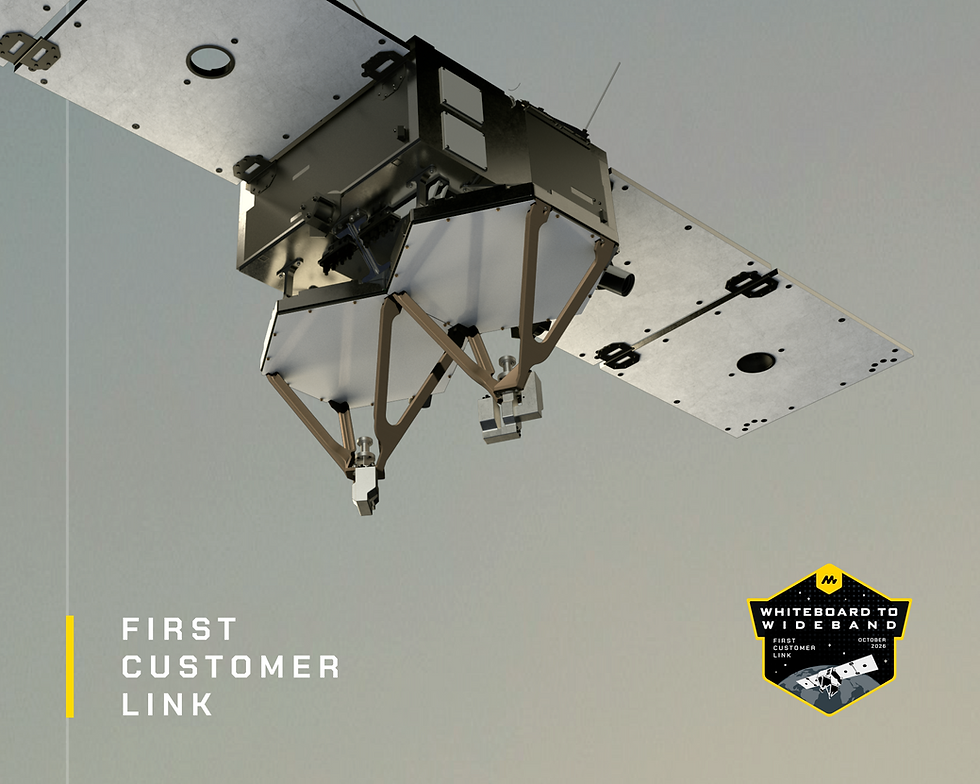
Meridian’s aim to develop 70-kilogram satellites that, when stowed for launch, would be less than two meters wide, a little over a meter and a half tall and 30-40 centimeters thick hinges on a low-profile antenna slated to fly on SpaceX’s next rideshare mission Oct. 1.
The antenna has been integrated with a standard cubesat from NanoAvionics to test a capability Ladovaz says would enable the thin satellite version to deliver “very high capacity, similar to any other broadband satellite,” while being 20 times more power efficient than legacy satellites in low Earth orbit (LEO).
“There’s an advantage to not being first: you can look at everything that was done before,” Ladovaz told SpaceNews via email.
“The team looked at the LEO constellations already being built and asked where the cost and complexity were coming from. One answer was the payload. By developing a high-performance, low-power antenna, we can build much smaller satellites.”
According to Meridian, this reduces the capital needed for a constellation, along with the number of rockets needed to put it in orbit, as SpaceX’s shift from its Falcon 9 workhorse to Starship development looks set to worsen an already constrained supply for launch capacity.
“This is now even more relevant as SpaceX looks to reduce the number of launches it makes available,” Ladovaz added.
“We designed the technology to address the cost, but it now also helps address a challenging launch market.”